The Stolen Children of Australia
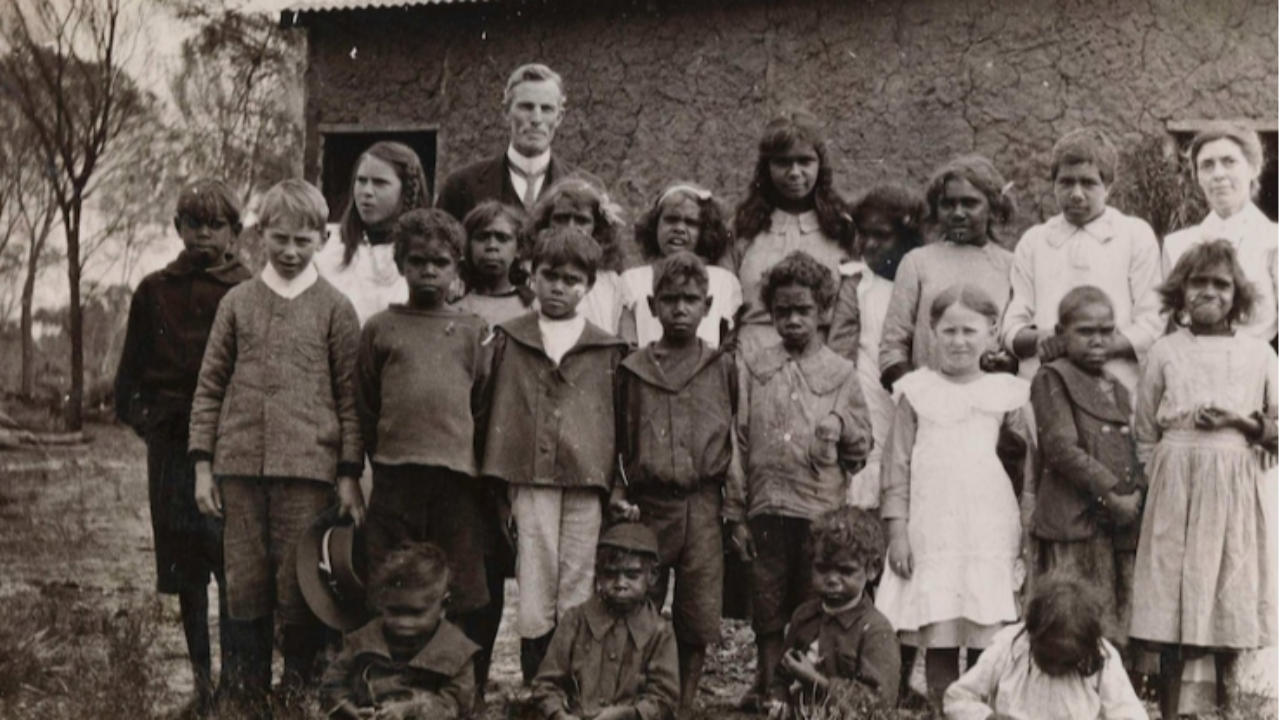
Dec 22, 2025Throughout human history there have been oversteps of power by government. Society is marred by the countless lawful and devastating procedures imposed by such power imbalances. The Stolen Generations, is the name given to the events that occurred to Aboriginal children over multiple generations. First from 1833, when aboriginal children were removed from their parents. Then from 1905, where it happened again and also included ‘half-cast’ aboriginal children. Here I uncover what the removal policy was all about. How it relates to our schooling system today, and how the aboriginal community have been impacted by these events.
The First Recorded Removal
The first recorded removal of a Noongar child in the Swan River Colony was in 1833. Lt. Governor Irwin wrote to his superiors in London after the execution of Noongar Elder, Midgegooroo. Irwin writes in relation to Midgegooroo’s eight-year-old son, Billy:
“The Child has been kept in ignorance of his father’s fate and it is my present intention to retain him in confinement and by kind treatment I am in hopes from his tender age, he may be [accustomed] to civilized habits, as to make it improbable he would revert to a barbarous life when grown up”[1]
It is unknown how many children were removed from their parents in these early years. Documentation is sparse and reports from the time lack detail. This is likely due to the fact that the first law in Australia, to officially sanction the removal of children, was the Industrial Schools Act of 1874, four decades later. The Industrial Schools Act stated that:
“Any Indigenous child ‘surrendered’ to an institution could be detained there without parental consent, or contracted to employment after the age of 12 until the child reached 21 years.”[2]
These laws were similar to those against the Native Indian Americans in the U.S. (Read about the Native Indian American Cultural Genocide here >)
Forced to Attend School
Like the Native Indian Americans, Aboriginal children were forced to go to public government funded schools. To be programmed to assimilate into the Anglo-Australian ways, so they could fit into ‘civilized’ culture. Compulsory schooling first started in Victoria with the Education Act 1872. This Act required all children aged 6 to 15 to attend school unless they had a reasonable excuse not to. New South Wales introduced the Public Instruction Act in 1880, making schooling compulsory. Queensland made schooling compulsory in 1875, Tasmania in 1893, and Western Australia in 1893. By 1908, all six states of the Commonwealth of Australia had centralized government departments administering free, compulsory, and secular education. The reason the Industrial Schools Act was created was to give the government power over indigenous peoples. To lawfully enslave children into work without their parents getting in the way.
This may seem completely unrelated to schools today but the model of compulsory schooling is designed to assimilate children into society. To equip them with the necessary skills for ‘difficult manual tasks,’ to destroy their free will, and mold them to be docile citizens. This, though conspiratorial sounding is proven through historical investigation. Prominent leaders and figures leading up to the formation of compulsory schooling stated the true purpose of schools. It wasn’t about education; it was about creating docile workers for the elite. The everyday folk, you and me, viewed as disposable cogs in a machine. (read more about the dark roots of the mandatory schooling system here >)
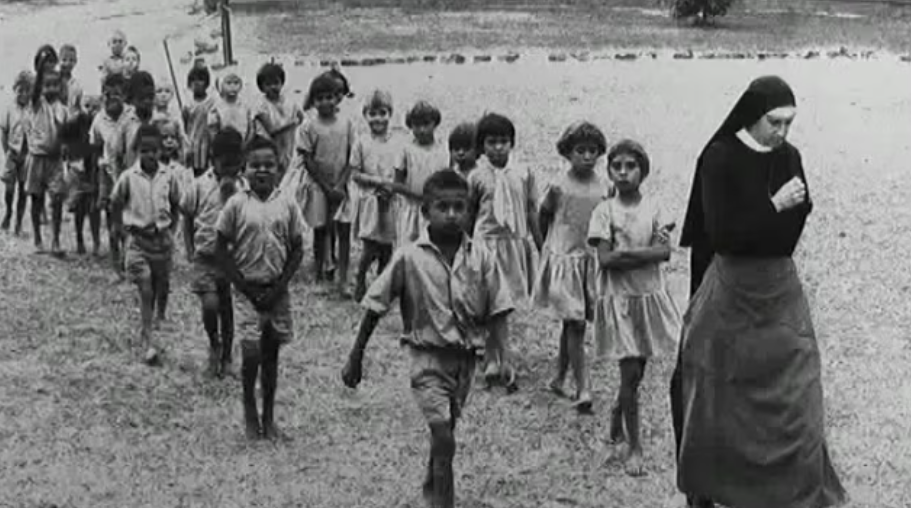
- A nun leading children to march at the New Norcia Mission (Supplied: Dumbartung Aboriginal Corporation)
Controls on Aborigines
The Aborigines Act, 1905, incorporated an assessment of ‘behavior’ to determine whether an individual should be defined as Aboriginal or not. The Chief Protector of Aborigines became the legal guardian of every Aboriginal child. He had the power to remove any child born of ‘half-caste’ or an Aboriginal mother to a home or mission. The number of missions and settlements in Australia exploded from 1905, to 1915. During this time, Auber Octavius Neville became the Chief Protector of Aborigines.[3] Neville was a strong advocate of assimilation and thought children of mixed descent should be absorbed, racially and culturally, into the general population and that all aborigines should be bred out. These sentiments he shared in his book Australia’s Colored Minority published in 1947.[4]
He served as the Chief Protector of Aborigines in Western Australia from 1915 to 1936. A short while after, Neville became Commissioner for Native Affairs under the Native Administration Act, until his retirement in 1940.

- Auber Octavius Neville
The Voices of the Stolen
The ‘Stolen Generations Testimonies’ project (SGT) is an online collection of testimonies from Australia’s Stolen Generations Survivors. The online museum features more than thirty testimonies and lends insights into the experiences of many Indigenous Australians whose voices were never heard or shared. SGT preserves the stories of survivors and acts as a time capsule. SGT allows Australians and the world to know what happened to many Indigenous children. Children who were taken from their families and forced into mission houses, foster homes, and schools, legally, due to discriminatory laws against Indigenous Peoples. The stories expose the cultural genocide that the government ‘lawfully’ committed. While also exposing the air of denial and mis-understanding within the Australian public over what occurred during the decades the Stolen Generation schemes ran.
STOLEN AS A BABY
Debra Hocking,[5] an SGT board member & Deputy Chair of the Aboriginal & Torres Strait Islander Healing Foundation, is a stolen generations survivor. Hocking was taken from her mother at just eighteen months old. She was given to a foster family that sexually abused her for years. She ended up running away and living on the streets. Eventually, she got herself a job and felt called to search for her mother. She went to the authorities who had taken her as a baby, they told her they could not help her. Hocking unwilling to go home empty handed, silently protested staying at the office. Until, someone did help her and gave her ten minutes with her file. She took note of her mother’s address, and any details she could.
Hocking recalls crying with her mother who said ‘I knew you’d come’ when they first met. Sadly, Hocking had little time with her mother thereafter. Shortly after their first meeting, was their last when Hocking’s mother lay dying in hospital. Hocking acknowledges the time she lost with her mother and how that has negatively impacted her family, even to today.
Reclaiming Her Identity
Hocking said there was a process of ‘reclaiming her identity.’ ‘Your culture is deeper than your skin,’ she said when explaining her pale color and heritage. Hocking describes an innate need to dig a hole, surround it with stone and make a fire. She believes this to be part of her cultural spirit. She later found that it was something she shared with her mother, whom also made fire pits in their yard despite being told not to. Hocking was removed from her mother on the grounds of neglect. Neglect was a vague term that allowed authorities to decided what they deemed was neglect. ‘We’ll say its neglect if you don’t do as we say,’ Hockings quoted. She later found that her mother had written to the authority’s numerous times in hopes of getting her children back. In her letters she expressed her love and commitment to her family.
THE GROUNDS OF REMOVAL
The government took children on the grounds of wellbeing but the true reason for removal was about forcing cultural shifts. To assimilate Indigenous peoples from an early age when they are most influenced and developing their sense of identity.[6] Authorities removed the ‘half-caste,’ children, like Hocking, from their Indigenous homes and communities believing they could assimilate and be part of the ‘main stream’ more easily, than their darker skinned kin. These ‘half-caste’ children were said to have:
‘Inherited the vices but none of the virtues of both races, the white part of their ancestry was said to raise them above the aborigines.’[7]
The government and authorities at the time saw dark skin as a necessary attribute of Indigenous people. Therefore, without such pigmentation one could simply be Western if removed from the Indigenous influences. Removing darker skinned children from their Indigenous parents was justified by the belief that the ‘lifeways’ in the culture once removed, at an early age, would also assimilate the individual into Western culture by the time they were an adult.[9]
THE EXPERIENCE OF THE CHILDREN INSIDE THE MISSION HOUSES
Daniel Forrester,[10] says his mother gave him over because the authorities had a way of making Indigenous people hand over their kids. He believed his mother was tired of hiding her ‘half-cast’ kids. Forrester spent nine years in the home and ‘lost a lot of closeness with his parents’. He said he was one of the lucky ones because he knew his parents unlike some of the younger kids at the home. This segregation was part of the program to assimilate young children, removing them from all other influences was effective in alienating them from their culture, and identity, creating a type of dysphoria.[11]
He describes waking, doing chores, going to church, and having to be clean and ready for school. Then he went back to the home for the bell to signify supper and the evening church service. His life was a series of practices that were designed to indoctrinate him into the Western ways.
The Treatment of the Children
Forrester had his mouth washed out with soap and was told to ‘stop being a savage’ on several occasions for various things. Though it’s normal for young children to misbehave and test the boundaries, guardians saw how the children were acting as cultural issues rather than phases that accompany growing up. The word ‘savage’ was used because of the beliefs held about Indigenous Peoples. This was based on ideas of the time about Indigenous heritage and the biases attributed to them.[12] This treatment makes it clear that these stolen children, though in an assimilation scheme, were still being treated as if they were intrinsically different from those who were in guardianship of them.
Forrester recalls children being forcibly held under the cold shower water in winter; holding their breath because of the cold. The abuse the Stolen Generations endured, points out the very evident fact that this removal program was never about the safety of the children. Like Hocking, Forrester was also sexually abused by some of his guardians. Unfortunately, their experiences are not isolated as many people from the Stolen Generations have come forward to testify that abuse was also something they endured as well. Forrester points out that sharing was taboo at first, and only now that he is in his 60s do people share openly and honestly. He believes this is because many of them had become aware that they were not alone in the abuse. The silence was in-part due to authorities denying peoples claims, and the fear of what would happen after coming forward.
The Unknown Impact
Unfortunately, the exact number of children removed from their parents isn’t known because not all of the children that were taken had a file, nor were they documented in any other way, because of this there are only estimates based on population and anecdotal evidence. Which estimates between 20,000 and 100,000 children being taken between 1883 and 1969 during what is known as the Stolen Generations.[13] The aim of the government in taking these children was to institutionalize them. To cut them off from their family and culture, even keeping siblings separated to ensure isolation.
Despite the government policies and the ‘Bring Them Home’ report in 1997 there seems to be confusion and debate within Australia over the Stolen Generations and what took place. Anna Haebich describes an:
“Apparent collective amnesia has left the burden of public recall to the surviving members of the Stolen Generations.”[14]
Non-Indigenous-Australians while sympathetic to the accounts of survivors, are far removed from the instances that took place. Some might deny the events, while others might brush it off relaying what political leaders have claimed as ‘removal for the good of the child,’ causing disbelief in the idea that these stolen children have been mistreated.[15] This is a large barrier to true reconciliation.
Final Thoughts
The ramifications of the Stolen Generations are felt throughout Indigenous communities.[16] A lack of recognition, acknowledgment and understanding of what happened has caused a wedge between people in Australia.[17] Through the testimonies’ recorded by SGT it is clear that the Australian government’s actions were an attempt at cultural genocide. It is also clear that thousands of people have been harmed by these events.
It is worth mentioning that the Australian public did begin to get active in ensuring rights for Indigenous Australians. However, large change didn’t really happen until the 1960s when a referendum was held. During this time organizations such as the Women’s Christian Temperance Union joined the cause. (which you can read more about here>). This ensured indigenous women had the same rights as non-indigenous, ultimately protecting their children.
It is clear that it is up to the next generations, Indigenous and non-Indigenous to continue discussion and ensure positive change for a more unified future.[18]
References
[1] A. Haebich & A. Delroy, The Stolen Generations: separation of aboriginal children from their families in Western Australia. Western Australian Museum, Perth, 1999, p.8
[2] D. Mellor and Haebich, A. (eds). Many voices: reflections on experiences of Indigenous child separation. National Library of Australia, Canberra, 2002, p.249
[3] J. Carter, History of the Removal of Aboriginal Children from their Families in Western Australia 1829 to 1972. AAD contribution to the State submission to the Human Rights and Equal Opportunity Commission National Enquiry into Separation of Aboriginal and Torres Strait Islander Children from their Families. Aboriginal Affairs Department, Perth, (1996): 12
[4] Neville, Auber Octavius. Australia’s Coloured Minority: Its Place in the Community. 1947
[5] Hogan, M., (2024). b. Debra Hocking [Video]. Stolen Generation Testimonies, Vimeo, 30 min, 52 sec. https://www.stolengenerationstestimonies.com/testimonies/debra-hocking.
[6] N.S.W. Teachers’ Federation. “The Stolen Generation.” In Education : journal of the N.S.W. Public School Teachers Federation 64, no. 10 (1983). https://nla.gov.au/nla.obj-731398811.
[7] Austin, T. Australian and New Zealand History of Education Society. “Genocide and Schooling in Capricornia: Educating the Stolen Generation.” In History of education review 29, no. 2 (2000): 51. https://nla.gov.au/nla.obj-2845035972.
[8] Holliday, A., Hyde, M., Kullman, J. “Defining Concepts.” In Intercultural communication : an advanced resource book for students, Third edition., Abingdon, Oxon, England :, Routledge., (2017): 1-5.
[9] N.S.W. Teachers’ Federation. “The Stolen Generation.” In Education. Public School Teachers Federation 64, no. 10 (1983): 15. https://nla.gov.au/nla.obj-731398811.
References Continued
[10] Hogan, M., (2024) Daniel Forrester [Video]. Stolen Generation Testimonies, Vimeo, 18 min, 19 sec. https://www.stolengenerationstestimonies.com/testimonies/daniel-forrester.
[11] Gilbert, S. (2019). Living with the past: the creation of the stolen generation positionality. AlterNative: An International Journal of Indigenous Peoples. 15(3), 226-233. https://doi.org/10.1177/1177180119869373.
[12] Holliday, A., Hyde, M., Kullman, J. “Addressing the Other.” In Intercultural communication : an advanced resource book for students, Third edition., Abingdon, Oxon, England :, Routledge., (2017): 26.
[13] National Inquiry. 1997. “Bring them Home Report.” https://bth.humanrights.gov.au/the-report/bringing-them-home-report.
[14] Haebich, A. “Between knowing and not knowing”: Public knowledge of the Stolen Generations. Aboriginal History 25, (2001): 70. http://www.jstor.org/stable/45135472.
[15] Ibid: 70-71
[16] Gilbert, S. (2019). Living with the past: the creation of the stolen generation positionality. AlterNative: An International Journal of Indigenous Peoples. 15(3), 226-233. https://doi.org/10.1177/1177180119869373.
[17] Haebich, A. (2001). “Between knowing and not knowing”: Public knowledge of the Stolen Generations. Aboriginal History, 25, 70–90. http://www.jstor.org/stable/45135472.
[18] Murrup-Stewart C, Whyman T, Jobson L, Adams K. (2021). “Connection to Culture Is Like a Massive Lifeline: Yarning With Aboriginal Young People About Culture and Social and Emotional Wellbeing.” Qualitative Health Research 31(10):1833-1846. doi:10.1177/10497323211009475.
Join the movement to rethink education
Get ideas, stories, and tools for raising free thinkers and world changers.
We hate SPAM. We will never sell your information, for any reason.