
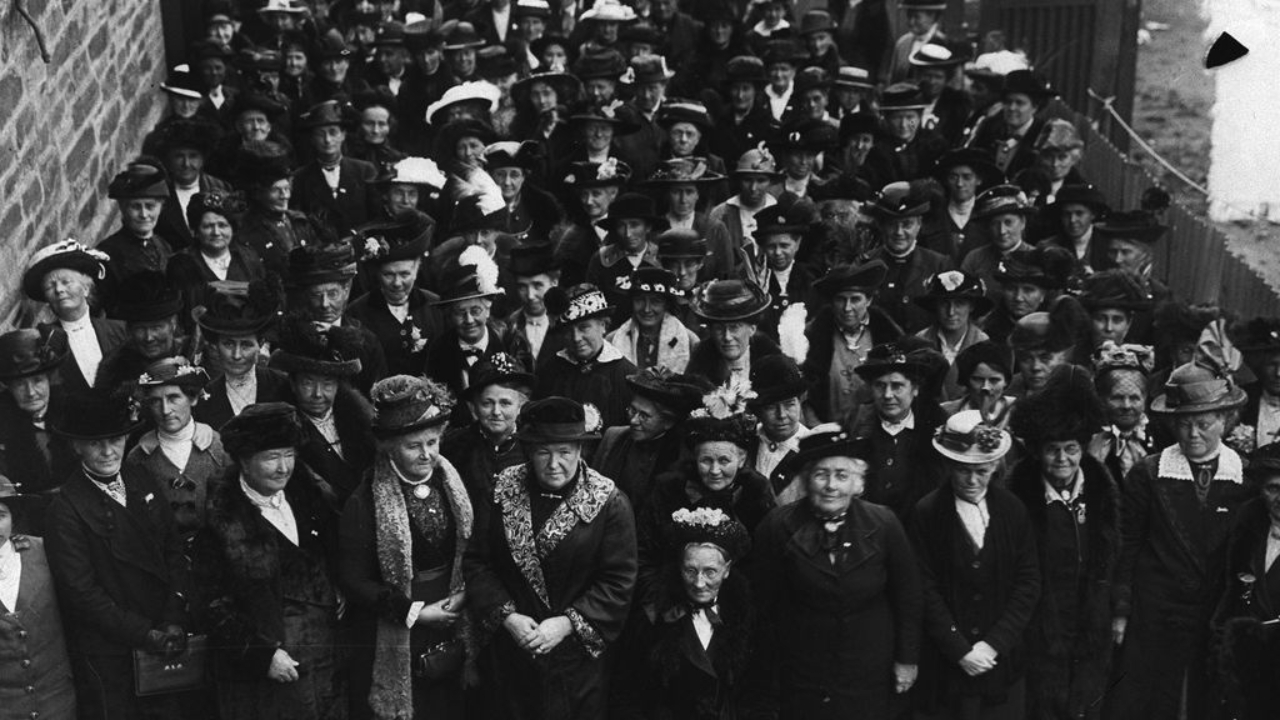
You Need to Know: The Significance of the WCTU
Oct 18, 2025Every now and then, governments implement laws that seem like a gross overstep on people’s personal liberties. Sometimes these laws are at the behest of a government wanting to assert dominance and more control over its citizens. While other times it is the wishes of a loud group of people, within the population, who are unhappy with the current social climate. Such groups influence the government to implement liberty stealing laws that pervade thereafter. Furthermore, these laws set a new precedent. One such group was the Australian Woman’s Christian Temperance Union (WCTU), formed in 1882. Primarily created out of necessity and a deep need to end household violence inflicted by drunken husbands and fathers that endangered women and children.
There was an influx of alcohol production and consumption that led to increases in crime, violence, and homelessness. Drunkards were unable to hold down a job and often left their family in squalor as they spent anything they did earn on liquor. The WCTU published a statement, in The Maitland Daily Mercury, saying:
“Home protection, prohibition of the liquor traffic, equal suffrage, one standard of morals and the bringing about of a better public sentiment.” [1]
The WCTU in Australia had good intentions and teachings but lacked the foresight of how their actions would impact law and society in the future. Though equal suffrage did lead to women being able to vote, the alcohol temperance laws across the country have encroached on people’s personal liberties. Prohibition laws in America may have been stricter and nationwide, but Australian states continue to push temperance laws on its citizens even today. To understand the WCTU intentions and how their actions have impacted Australians, one must first look at their beliefs and where the idea of temperance came from.
Religious Ethos Behind Temperance
Temperance means abstaining from excess. Galatians 5:22-23 (King James Version Bible/ KJV) teaches Christians that:
“… the fruit of the Spirit is love, joy, peace, longsuffering, gentleness, goodness, faithfulness, Meekness, temperance: against such there is no law.”
These are the fruits, the resulting character of being Christian and housing the Holy Spirit. However, the Bible also implies that a believer may not necessarily possess all such qualities but would ideally move toward them in their walk of faith.[2] Throughout the Bible, are teachings that relate back to these fruits and the way believers should behave within their position be it as a general believer, mother, father, husband, wife or religious leader. The Bible instructs leaders to ‘practice what they preach’ and be more upstanding than the rest of the congregation, as they are the example.
When Men become fathers, they are held to this leadership standard. The Bible teaches that the father is the head of the household and the leader of his family.[3] 1 Timothy 5:8 warns:
“… if anyone does not provide for his own, and especially for those of his household, he has denied the faith and is worse than an unbeliever.”
The Bible teaches that Fathers are providers.
What the Bible Says
There are various passages throughout the Bible that also explain how a man is to behave toward his children and his wife. Men are to be meek and gentle toward the “weaker vessel.” This may sound condescending or offensive in a ‘feminist world.’ However, it was in relation to the physical and emotional attributes, nothing to do with worth or worthiness. Men saw women as under their protection. Men are, on average, more dominant, show less erratic emotion, and are physically stronger than women.
Christians believe that men and women are specially designed to fit specific needs. Sir. Francis Bacon of England in 1612 argued that without God one cannot be noble and instead falls into depravity. With God he states that a man “rests and feels secure under divine protection and favor,” gathering “a force and faith that human nature in itself could not obtain…” [4] Such sentiments as Bacon and the aforementioned passages of the Bible, made Christian leaders and believers feel a responsibility to evangelize and lead the ‘sinful’ to faith. Temperance movement leaders, made depravity synonymous with alcoholism and so the aim was to move people away from such habits. With these passages and sentiments from Sir. Bacon it is clear that there were strong moral and service-based intentions behind the ideas of the temperance movement and organizations.[5]
How the WCTU saw the teachings of the bible
For the WCTU, temperance was not just about having more self-control, drinking responsibly or not giving into temptation, it was about salvation. Salvation and evangelism are a large part of the Christian ideology. Jesus Christ told his followers in the four gospel books, to spread the news of his life, death, and resurrection. To bring people to faith and ultimately save their souls from damnation. A Christians ultimate calling is to ‘save souls for Gods kingdom,’ by spreading the gospel. The women of the WCTU were adamant and driven to villainize alcohol. The WCTU and other temperance leaders, made alcohol a weapon of temptation claiming that it leads people to an early grave, and hell.
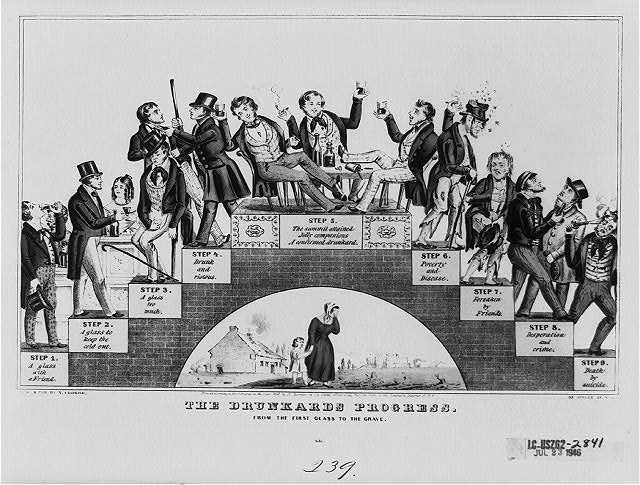
The drunkards progress. From the first glass to the grave / lith. & pub. by N. Currier. , ca. 1846
The Start of a Union and Continuation of a Movement
The WCTU was founded in America 1874, nearly a decade before Australia started their first union. In 1882, the Sydney Christian Ladies’ Temperance Union (SCLTU) was created.[6] The temperance movement itself began in America decades earlier in the 1820’s. The earliest temperance organizations were founded at Saratoga, New York, in 1808 and in Massachusetts in 1813. The movement gained significant momentum with the founding of the American Temperance Society in 1826 by evangelical Christians. They aimed to change attitudes towards alcohol consumption.
Though the movement began in the early 19th century with a focus on moderation the ideas and aims shifted by the mid-1800s to advocating for abstinence from alcohol. Temperance leaders employed prayer and public meetings to encourage pledges of abstinence. The WCTU once founded, became a powerful force in the promotion of temperance as a moral and social imperative. In 1879, Frances Willard became president of WCTU and expanded the organizations goals to women’s suffrage, social justice and education. Their campaigns and lobbying for local and state law played a crucial role in shaping public opinion.
Leaders of the Movement
These expanded goals led to the first world missionary of the American WCTU, Mary Leavitt. Leavitt travelled to various countries to help start WCTUs.[7] During her visit to Australia in 1885, she began establishing local branches.[8] The South Australian branch was formed, after her visit, in April 1886. Leavitt conducted many talks and gatherings about the cause and was a continual influence on female temperance unions in Australia.[9]
In 1891, Jessie Ackermann, the second world missionary of the WCTU, inspired the establishment of the first branch in Western Australia in York. The national organization, initially known as the Woman’s Christian Temperance Union of Australasia, was formally established in May 1891 at a meeting held in Melbourne. This gathering was likely the first interstate meeting of women’s organizations in Australia and marked the creation of the country’s first national women’s organization. Ackermann became the inaugural president of the federated Australasian WCTU. The organization’s primary objective was the prohibition of alcohol and/or individual abstinence. However, it did have the same expanded goals as the WCTU in America.
WCTU’s Victories and Failures: A Look at America and Australia
Throughout its existence the WCTU and organizations with a similar name i.e. the SCLTU, have been focused on prohibition, and the education of the public on the dangers of alcohol consumption. When Mrs. Leavitt’s visited Melbourne, Victoria in 1886, she spoke about the successes of the temperance movement in America aiming to encourage Australians to follow suit.[10]
The American temperance movement had gained significant political momentum through the Anti-Saloon League. Which emerged in the late 19th century and used sophisticated political strategies to influence legislation. The League, along with the WCTU and the Prohibition Party, applied sustained pressure on lawmakers to enact prohibition laws at the state and federal levels. This culminated in “scientific temperance” education in schools, which became federally mandated by 1901.[11] In 1919 the Eighteenth Amendment to the U.S. Constitution was drafted, which banned the manufacture, sale, and transportation of alcohol nationwide, and became effective January 1920.
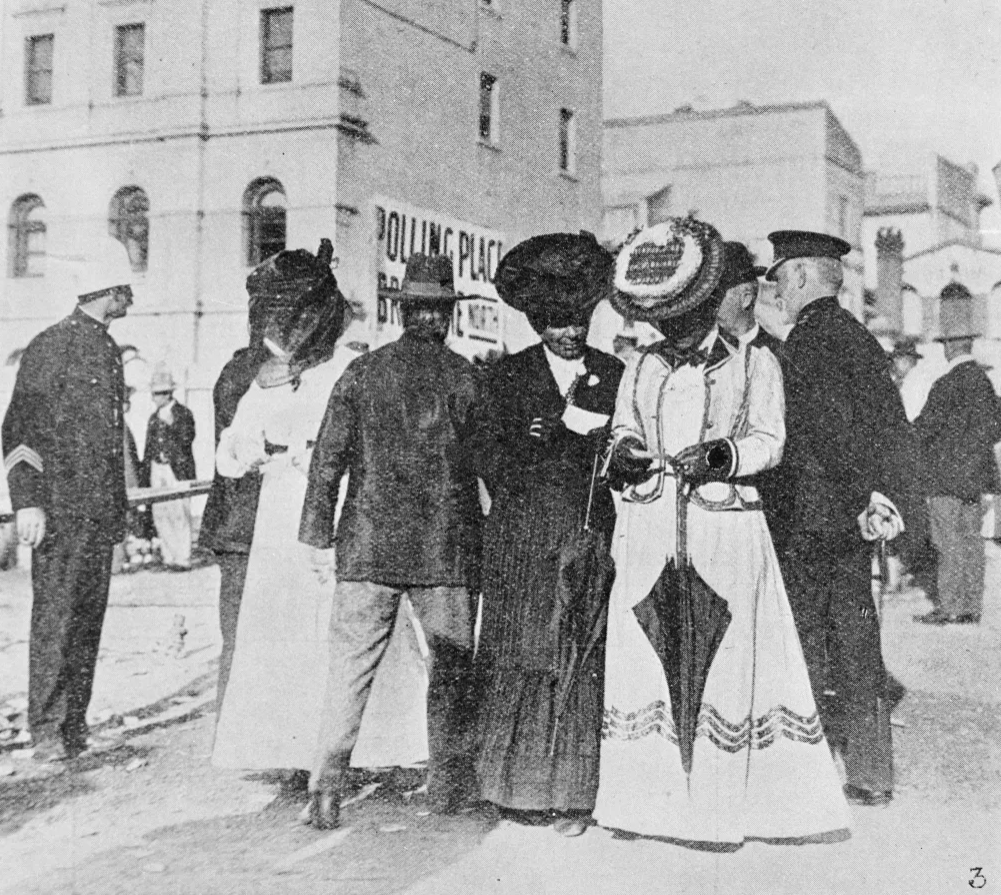
Women at the first state election comparing notes, Brisbane, 1907.
Differences Between America and Australia
Unlike America, Australian temperance and prohibition did not result in a nation-wide law to completely prohibit the sale or making of alcohol. It also did not result in mandates for scientific temperance education in schools. Instead, the states made laws and implemented them, with some states being harsher than others. The states placed emphasis on controlling opening hours of establishments that sold alcohol. Furthermore, they focused on educating the public, rather than forcing abstinence from alcohol consumption all together.
Perhaps the most successful outcome of both the American and Australian WCTUs was the clear message that women wanted better. Better treatment, respect, and political standing. Women orchestrated and attended campaigns and rallies, making it clear that they wanted to be seen and heard. This want and need manifested, in Australia first, as “the Commonwealth Franchise Act 1902.” This act “allowed non-Indigenous women in all states to vote and stand as candidates in federal elections.”[12] This was a big win for women in Australia that inspired women back in America. American women did not get the right to vote until June 4, 1919, when the nineteenth Amendment to the U.S. Constitution was approved.[13]
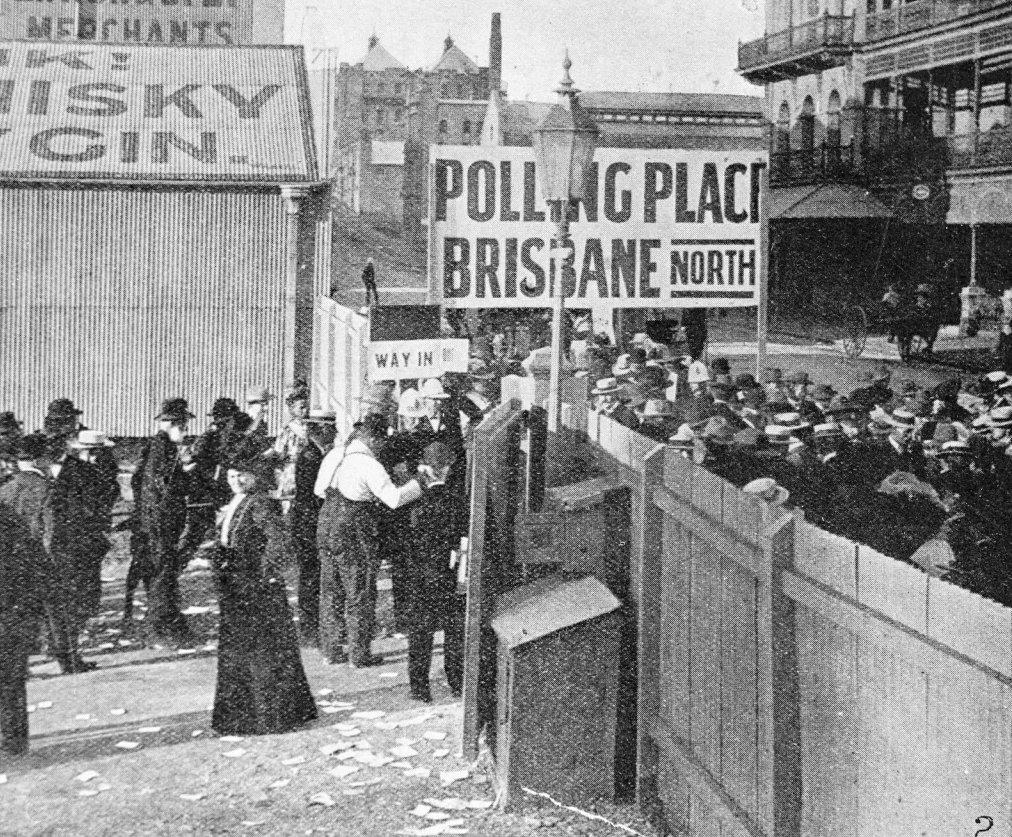
Women inside the gate of the city polling station voting for the first time. Queensland State Election May 1907.
Who was left out of the WCTU
Although the WCTU was fundamentally about protecting women and ensuring their rights politically and socially, there was a lack of acknowledgment and help given to the plight of aboriginal women. From 1910, half-cast (Aboriginal) children were being taken away from their parents, and given to mission houses, boarding schools, and adoptive parents.[14] Aboriginals were essentially treated as second class citizens at the start of the WCTUs campaigns. This is believed to be due to “colonial racism” underlying “the early enfranchisement of white Australian women.”[15] It is clear that the WCTU was not driven to help all women but instead focused on white or colonial women at first. This however changed in the 1930s, when there was a revision in WCTUs attitudes toward colonialism and the effects it had on Aboriginal people.
The WCTU gradually shifted from more protectionist and assimilationist views to ones stressing equality, cultural integrity, and Aboriginal independence and leadership.[16] WCTU leaders helped lay the groundwork for working co-operatively and on an equal basis with Aboriginal men and women through the Advancement Leagues that emerged in the late 1950s.[17] “It was not until 1962 that Aboriginal and Torres Strait Islander women were granted the right to vote.” Six decades after non-Indigenous women.[18]
Impacts of the WCTU on Society and Future Generations
The WCTUs victories live on today, as women head to the voting booth and run for political positions. However, their influence on temperance laws still persists and have long lasting negative effects on the Australian public as, the Laws that the WCTU influenced still impede individuals’ rights to buy, sell or consume alcohol as they like (without taking away someone else’s rights).
The Northan Territories for example has had a ‘Nuisance Public Drinking’ law in place since 2024, this was to lower crime and drunk driving, however, it has proven to be less effective than the government anticipated given that the laws effect, already less fortunate people, disproportionately indigenous individuals, who would benefit from more supportive services than restrictive laws.[19] New South Wales in contrast, has only recently been looking to loosen their drinking laws by allowing public drinking on the beach.[20] The government, together with advice from law enforcement and phycology experts, orchestrate these changes in law.
The government and ‘experts’ only superficially consider the public. Experts and politicians look at the crime rates, drunk driving deaths, and other drink related crimes without actually consulting the people. The WCTU set in motion a system that allows the Australian federal and state governments to make decisions that affect the public and extend past alcohol sales and consumption, and into other areas such as speech, education, overall voting laws, and so much more.
Final Thoughts
There is no denying the significance of the WCTU. Through the decades the WCTU has had a big impact on society, creating positive change like the voting rights for women. While also being the catalyst for negative change like the laws that still exist today and encroach on people’s civil liberties. It is clear that organizations have immense power and influence on the government and greater public. Such power should be wielded with the future in mind. Did the WCTU do more harm than good? Was there perhaps a better way to have conducted the temperance movement? These are the questions for influencers and growing public bodies to consider when wielding the power of influence.
References
[1] “Woman’s Christian Temperance Union.” The Maitland Daily Mercury (Apr 19, 1901) https://trove.nla.gov.au/newspaper/article/124111864
[2] King James Version Bible “Galatians 5” (1611)
[3] King James Version Bible “1 Timothy 3” (1611)
[4] Bacon, Francis., “Nobility,” (1612) Essays by Francis Bacon Francis Bacon 1597–1628 Copyright Jonathan Bennett 2023. https://www.earlymoderntexts.com/assets/pdfs/bacon1597.pdf
[5] King James Version Bible “1 Timothy 5” (1611)
[6] “Sydney Christian Ladies’ Temperance Union,” The Sydney Morning Herald, NSW. (September 5, 1882) https://trove.nla.gov.au/newspaper/article/28376635
[7] “W.C.T.U. President.” The Daily Herald Adelaide (February 9, 1912) https://trove.nla.gov.au/newspaper/article/105215760
[8] “Arrival of Mrs. Leavitt’s” Evening News Sydney, NSW (July 7, 1885) https://trove.nla.gov.au/newspaper/article/111010134. Grimshaw, Patricia. 1999. “Colonising Motherhood: Evangelical Social Reformers and Koorie Women in Victoria, Australia, 1880s to the Early 1900s.” Women’s History Review 8 (2): 332. doi:10.1080/09612029900200203.
[9] “Mrs. Leavitt’s Mission.” North Melbourne Advertiser, Vic. (March 19, 1886) https://trove.nla.gov.au/newspaper/article/66155643
[10] “Mrs. Leavitt’s Mission,” The Age Melbourne, Vic (March 26, 1886) https://trove.nla.gov.au/newspaper/article/199454231
[11] Chamberlain, Adam, and Alixandra B. Yanus. “Mobilizing Women to Vote? The Woman’s Christian Temperance Union and School Voting in Massachusetts, 1900–1909.” Journal of Women, Politics & Policy 46, no. 2 (2025): 113. doi:10.1080/1554477X.2025.2469917.
[12] “The right to vote” Women’s suffrage. National Library of Australia.https://www.library.gov.au/learn/digital-classroom/feminism-australia/womens-suffrage
[13] “Announcement of women’s suffrage amendment, 1920” Women’s Suffrage. Library of Congress. https://www.loc.gov/classroom-materials/elections/voters/women-suffrage.
References Continued
[14] Grimshaw, Patricia. “Colonising Motherhood: Evangelical Social Reformers and Koorie Women in Victoria, Australia, 1880s to the Early 1900s.” Women’s History Review 8, no. 2 (1999): 329–46. doi:10.1080/09612029900200203.
[15] Ibid: 333
[16] Grimshaw, Patricia. “Gender, Citizenship and Race in the Woman’s Christian Temperance Union of Australia, 1890 to the 1930s.” Australian Feminist Studies 13, no. 28 (1998): 209-212 https://doi.org/10.1080/08164649.1998.9994910., Smart, Judith, “Modernity and Mother-heartedness: Spirituality and Religious Meaning in Australian Women’s Suffrage and Citizenship Movements, 1890s-1920s,” in Women’s Suffrage in the British Empire: Citizenship, Nation, and Race, Routledge, (2000): 225-229. https://www.routledge.com/Womens-Suffrage-in-the-British-Empire-Citizenship-Nation-and-Race/Fletcher-Levine-Mayhall/p/book/9781138007338., Holland, Alison, ‘Post-war Women Reformers and Aboriginal Citizenship: Rehearsing an Old Campaign’, in Damousi, Joy and Ellinghaus, Katharine (eds), Citizenship, Women and Social Justice: International Historical Perspectives, Melbourne University Press, Melbourne Victoria, 1999, pp. 21-27 https://trove.nla.gov.au/work/162225560., Buchanan, Kelly, “Australia’s 1967 Constitutional Referendum Related to Indigenous People: The Women Who Campaigned for ‘Yes’” (March 8, 2017) https://blogs.loc.gov/law/2017/03/australias-1967-constitutional-referendum-related-to-indigenous-people-the-women-who-campaigned-for-yes/.
[17] Holland, ‘Post-war Women Reformers and Aboriginal Citizenship’ In Citizenship, Women and Social Justice, Melbourne University Press, (1999): 26-27. Buchanan, “Australia’s 1967 Constitutional Referendum Related to Indigenous People,” (2017)
[18] “The right to vote” Women’s suffrage. National Library of Australia.https://www.library.gov.au/learn/digital-classroom/feminism-australia/womens-suffrage
[19] “NT’s ‘nuisance public drinking’ law sees 120 people fined, three arrested.” ABC News on YouTube. 2 mins, 8 sec. 2025. https://www.youtube.com/watch?v=y_IafEqZ–U
[20] “Minns Government considering NSW public drinking laws overhaul.” 9 News Australia on YouTube. 1 min, 59 sec. 2024. https://www.youtube.com/watch?v=A40ZvwFfqJM
Don't miss a beat!
Be part of the EDH Family and Join our Newsletter for exclusive discounts and life changing strategies. Plus get the Family Activities Handbook PDF download straight to your inbox today!
We hate SPAM. We will never sell your information, for any reason.