
The American Civil War and a Quashed Reading Revolution
Dec 01, 2025The Civil War brought many changes across the United States of America, political, social, economic, and cultural, one perhaps overlooked change is literacy. Derek W. Black, author of Dangerous Learning: The South’s Long War on Black Literacy, stated that during the Civil War there was “a new birth of freedom in America through Black literacy.”[1] Many influential voices have given the credit for increased literacy rates in America to mandatory schooling. However, looking at history, it is clear that the literacy rates in America were already steadily growing in 1850, two years before the first mandatory schooling laws passed in Massachusetts. The Northern states showed 93% of their population as literate. The South however lagged behind, not because of a lack of mandatory schooling or a lack of a desire to read, but a criminalization of reading and writing. Let me explain…
Anti-Literacy Laws
Prior to making schooling mandatory in 1852, many American parents put family first. Education was given in life, at home, and through apprenticeships. Schooling was not viewed as necessary.[2]
Table 1: Adult Literacy, 1850 U.S. Census [3]
| Adult Literacy | Free | Free + Slave |
| Slave States | 81.10% | 59.12% |
| Southern States | 80.18% | 57% |
| Free States | 93.25% | 93.25% |
| Northern States | 93.11% | 93.10% |
| All States | 89.31% | 79.26% |
The literacy rates above were among the highest rates of literacy in the world.[4] What stopped the rates being even higher were the anti-literacy laws placed on African Americans and slaves. The importance of reading was well known in America. Pamphlets like Common Sense sold extremely well and spread across the country quickly during the American revolution. Reading was seen as an important skill to ensure liberty, one of Americas core values. (Read more about the American Spirit and Bill of Rights here >)
The slaves of America were predominantly African American. Slave runaways and revolts caused hysteria to ensue across the South. Which encouraged Anti-Literacy Laws across many states with severe sanctions on the enslaved persons if caught trying to read or write. These laws also threatened any black or white person caught teaching an enslaved person. Some states even criminalized free African Americans reading and writing too, for fear that they would help their enslaved brethren. The punishments for breaking Anti-literacy Laws (between 1740 and 1867) were fines, imprisonment, and even corporal punishment.[5]
One such law
Virginia Act against education of slaves of 1819, stated:
“That all meetings of free negroes or mulattoes, at any school-house, church, meeting-house or other place for teaching them reading or writing, either in the day or night, under whatsoever pretext, shall be deemed and considered as an unlawful assembly; and any justice of the county or corporation, wherein such assemblage shall be, either from his own knowledge, or on the information of others, of such unlawful assemblage or meeting, shall issue his warrant, directed to any sworn officer or officers, authorizing him or them, to enter the house or houses where such unlawful assemblage or meeting may be, for the purpose of apprehending or dispersing such free negroes or mulattoes, and to inflict corporal punishment on the offender or offenders, at the discretion of any justice of the peace, not exceeding twenty lashes.”[6]
The Case of Nat Turner
Nat Turner, an enslaved African American, crystalized people’s fears of revolt in 1831. Turner, a carpenter and preacher, led a four-day rebellion of both enslaved and free Black people in Southampton County, Virginia. He and his followers murdered 50-60 white men, women, and children. The Richmond, VA. said the attack was an attempt at the “extermination of the whites.”[7] Turner, and all his followers and accomplices were hung or shot, many were tried and convicted before their execution and many others were killed during the revolt.[8]
Turner explained his special gift of reading in his confession, which was published and shared with the public in 1831, he stated
“The manner in which I learned to read and write, not only had great influence on my own mind, as I acquired it with the most perfect ease, so much so, that I have no recollection whatever of learning the alphabet —but to the astonishment of the family, one day, when a book was shewn me to keep me from crying, I began spelling the names of different objects —this was a source of wonder to all in the neighborhood, particularly the blacks —and this learning was constantly improved at all opportunities.”[9]
This gift of reading, coupled with the visions he claimed to have, made his followers view him as a prophet.
Rebellion of the literate
Turners’ rebellion was attributed to his proficiency in reading and writing, which enabled him to make speeches and inspire his followers to join him in his ‘bloody’ mission. Turner believed he was acting on behalf of God, going from house to house killing every white master and their family.[10] The first killing was Turners own master whom he said was kind to him and he had no complaints about him, yet killed him. The words he spoke throughout his confession were that of a fanatic. According to other speakers after the confession he spoke without remorse and was calm and excited when talking about the people whom he had killed.[11] Though in some Northern papers like The Liberator in Boston, information on Turner was written in such a way as to garner sympathy. The papers informant said he [Turner] looked like:
“One of the most miserable objects he had ever beheld-dejected, emaciated and ragged.”[12]
It continues on by calling him a “poor wretch.” Describing his frequent desire to turn himself in while he was being hunted down. The slave insurrection, led by Turner was the catalyst to stricter laws on all black people, free and enslaved.[13]
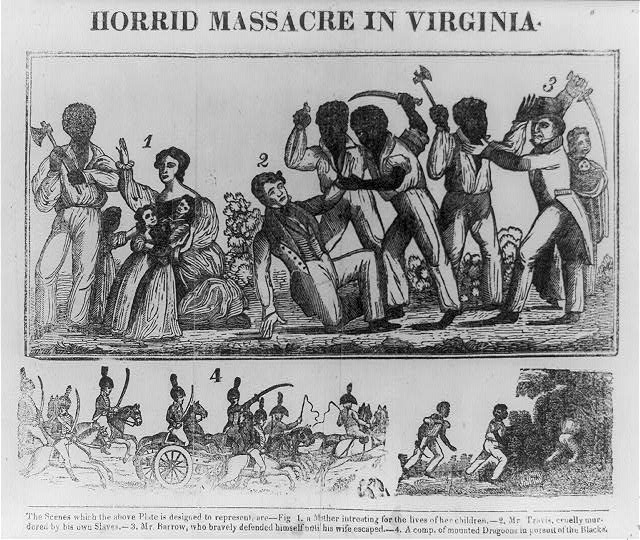
- Horrid massacre in Virginia (a depiction of Nat Turner and his followers.) 1831.[14]
North vs South
Due to these laws the country was divided and a gap of disparity was created to keep black people in the lower classes and enslaved in the South.[15] America relied heavily on slavery for its infrastructure, farming, and production. The Richmond Enquirer in Virginia published an article in 1857, that described abolitionists and the ideas of the Northern States as one in the same, claiming that they [the Northern people] were scattering their ideas over the South.[16] The aim of these kinds of publications was to position the North as “anti-southern” and their ideas as undermining the ‘Southern way of life,’ this led to the banning of many Northern publications in the South.[17]
The South claimed to be progressive, stating that they were naturally moving toward change and the emancipation of slaves. Still, owning slaves was considered a constitutional right in the South. The North, the Richmond Enquirer suggests, seeks to inspire slaves to revolt and encourages “their wild passions of vengeance.”[18] Many Northern publications implied that slavery went against the constitution, further adding to the animosity between the two sides.
Notable Influences

- Left – Susie King Taylor, 1902. Right – Washington, Booker T. [Between 1905 and 1945][19]
Susie King Taylor
Before the Civil War many enslaved African Americans still found ways to learn to read and write through secret schools and gatherings. Susie King Taylor, for example, was born into slavery in 1848. From the age of seven Taylor lived with her grandmother, who organized for her to go to secret schools because Georgia, where they lived, had strict laws against the education of African Americans. Taylor, at the age of just fourteen, was a very accomplished young lady and ended up teaching children and adults alike. She got her first position from Lieutenant Pendleton G. Watmough, who had been impressed with her skills while she was aboard a Union ship after fleeing from slavery with her uncle’s family, in 1862.
Not long after, Taylor joined the First South Carolina Volunteer Infantry where she officially served as a “launderette”. However, she did so much more than cleaning.
“There are many people who do not know what some of the colored women did during the war.”[20]
Taylor wrote in her book Reminiscences of My Life in Camp, published in 1902. Taylor states:
“I taught a great many of the comrades in Company E to read and write… Nearly all were anxious to learn…”[21]
Taylor’s testimony exposes the desire African Americans had for learning (read more about her story here), so too does the experience of Booker T Washington.
Booker T Washington
Washington was taught to read by his mother, who taught him with books like Webster’s ‘blue-back’ spelling-book. In his book Up from Slavery, published in 1901, he recalls that he always had a desire to read.
“I determined, when quite a small child, that, if I accomplished nothing else in life, I would in some way get enough education to enable me to read.”[22]
It was Washington who prompted his mother to teach him the skill.
It is important to note that while there were fears from enslavers that there would be revolts from educated slaves, some enslavers believed that literacy increased an enslaved person’s value.[23] This did not however encourage enslavers enough to go against state laws, which meant that African Americans would have to take great risks to be educated.
The determination and will to learn to read and write were the catalyst to great change and the real reason literacy rates in America rose. The laws began to be abolished in 1867, as a result of petitions from Black residents to the federal government. As well as the victory of the Civil War that emancipated African Americans from slavery and resulted in more literate African Americans than in previous years. However, many states tried to continue on with their discriminatory practices by other means, especially in the South where slavery had been most prevalent.
Segregation: Black Codes and Jim Crow Laws
Southern states enacted Black Codes starting around 1865 to control the lives of newly freed African Americans, dictating where they could live and work. These codes evolved into Jim Crow laws in the late 19th century,[24] which institutionalized racial segregation across the South, mandating separate facilities for whites and Blacks in schools, transportation, restrooms, restaurants, and other public spaces. Many states discouraged black people from reading, writing, and having a proper education. 1896 saw the Supreme Court decision in Plessy v. Ferguson, that upheld the constitutionality of segregation under the “separate but equal” doctrine.[25]
The U.S. Armed Forces were also formally segregated until 1948, with Black units separated from white units and typically led by white officers. Segregation was not limited to the South; it existed in both Northern and Southern states in transportation, public accommodations, and schools from 1849 to 1950. The Civil Rights Movement of the 1950s and 1960s challenged these systems, leading to landmark legal decisions such as Brown v. Board of Education in 1954, which declared segregated public schools unconstitutional, and the Civil Rights Act of 1964, which outlawed discrimination based on race, color, religion, sex, or national origin.
In this we can understand why lower literacy rates are still found in black communities even today.[26]

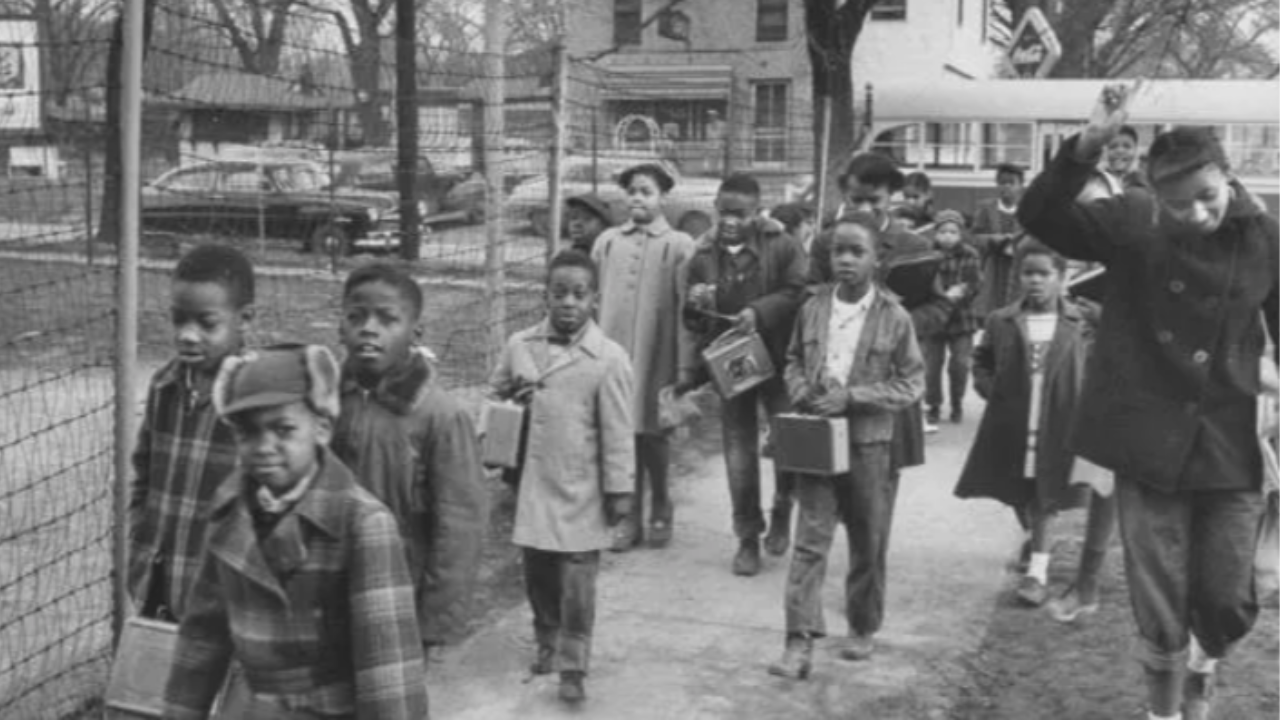
- Delano, At the bus station in Durham, North Carolina. 1940. [27]
Education Then and Now
After the emancipation of slaves. New schools were opened up for black students with teachers such as Susie King Taylor at the helm, however compulsory schooling laws swept the country, making schooling mandatory for all US children by the early 1900s regardless of color.[28] These laws and the subsequent government funded schooling facilities, forced Taylor and other educators to close their schools and quit teaching, as they were unable to gain positions as teachers; lacking the ‘proper qualifications.’ Taylor ended up becoming a domestic servant in 1868. Though these new government funded schools welcomed all US children, the segregation laws meant black children had their own state funded schools. They usually had much less funding than their white school counterparts. This caused a systemic failure across the board, effecting the opportunities students have and the quality of the teaching staff.
Veteran Teachers Favoring Certain Schools
Veteran teachers, have been found to favor teaching in schools with higher-income and lower-minority student bodies.[29] In this, it is clear that the laws, codes, and actions of the government and enslavers have had a lasting impact on society. African Americans in the 1800s came to America hoping for freedom and opportunity, some indenturing themselves just to get there.[30] These people had little money, and belongings upon their arrival to the US. A great percentage of African Americans were poor with only a small minority becoming wealthy, this is likewise similar for white Americans.
Forced schooling advocates accelerated their efforts after the Civil War especially in the Southern states. One can only deduce that such a push was to have control over the quality of education emancipated slaves and their brethren would have access to. Limited access to a quality education would ultimately stifle and limit opportunities for black people. However, this control went beyond race to encompass anyone born into poverty or lesser means than the more elite members of society.
The Elite Speak
In 1909, Woodrow Wilson, then president of Princeton University, said the following to the New York City School Teachers Association:
“We want one class of persons to have a liberal education, and we want another class of persons, a very much larger class of necessity in every society, to forgo the privilege of a liberal education and fit themselves to perform specific difficult manual tasks.”[31]
Four years later he became President of the United States, and is known for having made many reforms in education. Wilson’s words make it clear that the issues we see today in schools are systemic, and are caused by the intentions behind institutionalizing children. According to the WPR, “The state of California and the state Department of Education are being blamed and sued for the failing literacy rate, as families and students believe that they are not receiving a quality education in reading and writing.”[32]
The History of Schooling
If the greater public knew the history of compulsory schooling, it’s Prussian and classist foundations (Read more about this here), and how literacy has been, to a great extent discouraged and even systematically dumbed down for the masses, and not just for black minorities, perhaps there would already be greater innovation and less disparity.[33] Literacy protects democracy and human rights; it is through literacy that people are able to extend themselves past the station they were born into. Many scholarly articles overlook literacy as a systemic issue as their focus is on education and reform rather than history.
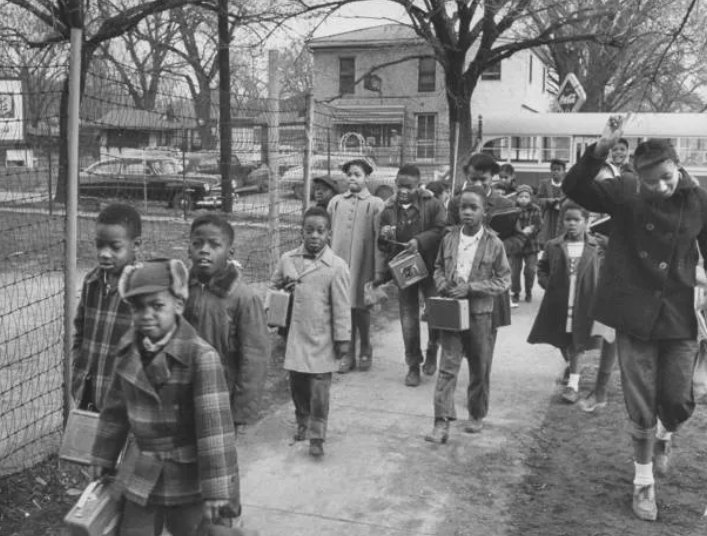
- Boys and Girls Heading to School.
Final Thoughts
There has been a clear systemic prejudice against minority groups, such as African Americans and lower-income households. The laws and codes that segregated Africans and other black Americans, blocking and discouraging them from reading and writing, have resulted in cultural damage and stereotypes of illiteracy. The withholding of education, essentially guaranteed cheap or free laborers for large corporations and industry. Black Americans could only find certain kinds of work, usually low paying and labor intensive.
African Americans fought for their right to be able to educate themselves, and that fight in many ways is still going on today. The literacy rates of African Americans did improve after the civil war, however there is still an inequality to the amount of funding given to less affluent areas that still tend to have larger populations of black people. The Civil war certainly resulted in higher literacy rates and more educational freedom initially. Those freedoms were short lived as laws were enforced to systematize and enable states to control the quality of education and opportunities available for black Americans and low-income earners.[34] There you have it a reading revolution quashed by government enforced mandatory schooling.
References
[1] Black, Derek W., Dangerous Learning: The South’s Long War on Black Literacy. Yale University Press. (2025): 390 Kindle Version
[2] Curtis, Bruce. Building the Educational State: Canada West, 1836-1871. Altare Publishing (1988)
[3] Historical, Demographic, Economic, and Social Data: The United States, 1790–1970. ICPSR00003-v1. Ann Arbor, Mich.: Inter-University Consortium for Political and Social Research. doi:10.3886/ICPSR00003.v1.
[4] Schweiger, Beth Barton. “The Literate South: Reading before Emancipation.” Journal of the Civil War Era 3, no. 3 (2013): 331–59. http://www.jstor.org/stable/26062071.
[5] General Assembly. “An Act to amend the act concerning slaves, free negroes and mulattoes.” (1831) In Encyclopedia Virginia (2020). https://encyclopediavirginia.org/primary-documents/an-act-to-amend-the-act-concerning-slaves-free-negroes-and-mulattoes-april-7-1831.
[6] General Assembly. “An Act to amend the act concerning slaves, free negroes and mulattoes.” (1831) In Encyclopedia Virginia (2020). https://encyclopediavirginia.org/primary-documents/an-act-to-amend-the-act-concerning-slaves-free-negroes-and-mulattoes-april-7-1831.
[7] Constitutional Whig. (Richmond, VA), Jan. 13 1832. https://www.loc.gov/item/sn83045110/1832-01-13/ed-1/.
[8] Ibid
[9] Turner, Nat. The Confessions of Nat Turner. Thomas R Gray. (1831): 8 https://dn790008.ca.archive.org/0/items/confessionsofnat00turn/confessionsofnat00turn.pdf.
[10] Ibid
[11] Ibid: 18-19
[12] Carroll, Thomas K. “Slavery Record.” The Liberator. Boston, MA, (Nov. 12 1831)https://www.loc.gov/item/sn84031524/1831-11-12/ed-1/.
[13] Mac Kilgore, John. “Nat Turner and the Work of Enthusiasm.” PMLA 130, no. 5 (2015): 1347–62. http://www.jstor.org/stable/44017155.
[14] Horrid massacre in Virginia. Southampton County Virginia, 1831. Photograph. https://www.loc.gov/item/98510363/.
[15] Willis, A.I. (2023). Anti-Black Literacy Laws and Policies (1st ed.). Routledge. https://doi.org/10.4324/9781003296188
[16] Richmond Enquirer. “Clapping the Climax” In Richmond VA, Nov. 5 1847 (1847):1 https://www.loc.gov/item/sn84024735/1847-11-05/ed-1/.
[17] Black, Dangerous Learning, (2025): 408 Kindle Version
[18] Richmond Enquirer. “Clapping the Climax” 1847
References Continued
[19] Susie King Taylor, known as the first African American Army nurse. United States, 1902. [Boston: Published by the author, from a photograph taken earlier] Photograph. https://www.loc.gov/item/2003653538/. Harris & Ewing, photographer. WASHINGTON, BOOKER T. , None. [Between 1905 and 1945] Photograph. https://www.loc.gov/item/2016857182/.
[20] Taylor, Susie K. Reminiscences of My Life in Camp: with the 33d United States Colored Troops, Late 1st S. C. Volunteers. Susie King Taylor. (1902) :67
[21] Taylor, Reminiscences, (1902): 21
[22] Washinton, Booker T. Up from Slavery: An Autobiography. (1901) On Project Gutenberg (2000)
[23] Encyclopedia Virginia“Literacy and Education of the Enslaved in Virginia.” https://encyclopediavirginia.org/entries/slave-literacy-and-education-in-virginia/
[24] Library of Congress. “Primary Source Set: Jim Crow and Segregation.”(1863-1970)https://www.loc.gov/classroom-materials/jim-crow-segregation/
[25] Library of Congress. “Plessy v. Ferguson: Primary Documents in American History.” (1896-1954) https://guides.loc.gov/plessy-ferguson.
[26] Cohen, D. J., White, S., & Cohen, S. B. (2012). Mind the Gap: The Black-White Literacy Gap in the National Assessment of Adult Literacy and Its Implications. Journal of Literacy Research, 44(2), 123-148. https://doi.org/10.1177/1086296X12439998., and Haynes-Taylor, Ingrid Dr. “2024-2025 Literacy Statistics.” National Literacy Institute. (2025), https://www.thenationalliteracyinstitute.com/2024-2025-literacy-statistics
References Continued
[27] Delano, Jack, photographer. At the bus station in Durham, North Carolina. Durham North Carolina United States, 1940. May. Photograph. https://www.loc.gov/item/2017747598/.
[28] Roussel, Ella Rose. “The Dark Secrets of Schooling! You need to know!” Educational Heart. https://educationalheart1.wpcomstaging.com/the-dark-secreats-of-schooling/
[29] Marguerite Roza, “How Districts Shortchange Low-income and Minority Students,” in The Education Trust, “Funding Gap 2006,” pp. 9–12, at http://www.edtrust.org/sites/edtrust.org/files/publications/files/FundingGap2006.pdf(April 2, 2011).
[30] Galenson, David W. “The Rise and Fall of Indentured Servitude in the Americas: An Economic Analysis.” The Journal of Economic History 44, no. 1 (1984): 1–26. http://www.jstor.org/stable/2120553.
[31] “A quote by Woodrow Wilson”. theysaidso.com, 2025. https://theysaidso.com/quote/woodrow-wilson-we-want-one-class-of-persons-to-have-a-liberal-education-and-we-w
[32] “U.S. Literacy Rates by State 2025.” World Population Review. (2025) https://worldpopulationreview.com/state-rankings/us-literacy-rates-by-state.
References Continued
[33] Roussel, Ella Rose. “The Dark Secrets of Schooling! You need to know!” (2025) https://educationalheart1.wpcomstaging.com/the-dark-secreats-of-schooling/., Cohen, et al, “Mind the Gap,” Journal of Literacy Research 44, no. 2 (2012):123 – 148. https://doi.org/10.1177/1086296X12439998. Thomas B. Parrish and Christine S. Hikido, “Inequalities in Public School District Revenues,” National Center for Education Statistics, July 1998, pp. 4–5, at http://nces.ed.gov/pubs98/98210.pdf(April 2, 2011). [1] Levinson, M., Geron, T., & Brighouse, H. (2022). Conceptions of Educational Equity. AERA Open, 8. https://doi.org/10.1177/23328584221121344 (Original work published 2022) Hill, James. “Press Release: New Report Finds Most States Have Deprived Schools of Hundreds of Billions of Dollars Since 2016 The sixth edition of “The Adequacy and Fairness of State School Finance Systems” shows African American students are three times more likely than white students to live in “chronically underfunded” districts.(2024) https://www.aft.org/press-release/new-report-finds-most-states-have-deprived-schools-hundreds-billions-dollars-2016
[34] Roussel, Ella Rose. “The Dark Secrets of Schooling! You need to know!” (2025) https://educationalheart1.wpcomstaging.com/the-dark-secreats-of-schooling/
Don't miss a beat!
Be part of the EDH Family and Join our Newsletter for exclusive discounts and life changing strategies. Plus get the Family Activities Handbook PDF download straight to your inbox today!
We hate SPAM. We will never sell your information, for any reason.