

How the ‘Bill of Rights’ Shaped National Identity in America
Nov 24, 2025After the American Revolution there was a growing divide among the thirteen colonies in the United States of America (USA). With many of the people hesitant to agree to a national government. The people had fought hard for their independence and separation from Britain, and now sought to maintain their freedom. The colonies worked together through a provisional government called the Continental Congress, which had no real power over the colonies. In May 1787, representatives from most of the states came together for a Constitutional Convention, to devise a new national Constitution. Which resulted in The Constitution of the United States of America.
The Constitution once written required all colonies to agree to its terms and thus a ratification process began. During ratification, debate within the colonies and among the thought leaders raged. Those for and opposed to a federal government spoke out with their opinions, concerns, and grievances to persuade others to join their position. The Bill of Rights (BOR) ultimately came to be because the people demanded their personal liberties be protected. Only five colonies agreed to the constitution without a BOR.
James Madison, the author of the BOR, did not think it necessary to have one. However, due to increased anti-federalist sentiments, the need to ratify the Constitution became apparent. Madison became a spokesperson for the BOR on behalf of the people. To understand how the BOR helped shape the culture and nationalistic identity of American citizens, in the early years of its independence, we must look at the events that occurred before its drafting.
The Continental Congress v King George III
Firstly, I must discuss the lead up to the creation of the Constitution.[2] Such events set the stage for the BOR and laid the foundation for a nation that values freedom and liberty. In 1774 the first Continental Congress convened to discuss ongoing issues in the colonies. Fifty-six delegates from twelve of the thirteen colonies were there to represent the people. They were often chosen by the people, the colonial legislatures, or by the committees of correspondence of the respective colonies. The Colonial Congress; not considered a federal government, had limited power. They were part of a collaborative military and negotiation strategy for the USA.
In the lead up to the first Continental Congress meeting, British authorities had “closed the port at Boston, altered the charter of Massachusetts, changed judicial procedures, and made it possible to billet soldiers upon the inhabitants of the colony.”[3]
The colonists became angry with the conditions and regulations put upon them from the British. Rebellion ensued.
king george loses control
The more King George III attempted to enforce Britain’s control over America the more insurgency grew. During the 1774 meeting, several important documents were drafted and agreed upon by the delegates. The Declaration of Rights and Grievances, and the Suffolk Resolves. The resolves discussed the building of a militia, boycotting the purchase of British goods, all colonists to stop paying taxes and to stop obeying the coercive acts of the British authorities.[4] While the declaration, was to be sent to King George III demanding that the colonists have the same natural born rights as the British subjects. The right to life, liberty, and property.[5]
Before the meeting disbanded, they made a plan to meet again if the King did not answer favorably to their declaration. Which of course he did not.
americans demand their rights be protected
The second Continental Congress met in 1775. They drafted and sent the Olive Branch Petition. In which the delegates told the King, that they wanted peace with Britain, their rights protected, and the taxes put upon them repealed. When there was no answer to this, the Declaration of Causes was approved. It outlined why the delegates felt it was necessary to take military action against the British government. King George III, issued the Proclamation of Rebellion,[6] to end the American rebellion and bring the traitors to justice.
War ensued, which fueled a great debate about whether Americans should become independent from Britain or try to reconcile. The first and second meeting of the Continental Congress and the resulting documents, form a definitive recognition of the wants of the colonialists. The American people wanted their rights and to live their lives as they had when they first settled on American soil. They had been living virtually unhindered by the crown that was primarily focused on its citizens in Britain, but had now begun to focus more on America.

- Washington and the Continental Congress
Common Sense
Thomas Paine published a 47-page pamphlet entitled Common Sense, in which he describes government as: wicked, negatively impacting our happiness by restraining our voices, and the facilitator of distinctions instead of encouraging social intercourse. Paine also describes government as a punisher and says that in its best state it is “but a necessary evil.”[7] He explains that the design of government emerged from our, humanity’s, wickedness, in order to restrain vice. The pamphlet was an instant sensation, convincing its readers that it was time to separate from the British tyrannical monarchy.
Historians believe, by the end of its first year of publication, nearly half of the population of the thirteen colonies had read or heard Common Sense. This included the illiterate who heard it in public gatherings.[8] The piece sparked debate and a movement toward independence. In later additions Paine became more serious. Paine told his readers that the only way to end the war was through standing united together against the common enemy, the British. He argued that the alternative, reconciliation was not possible, given how the crown had treated the American people.[9] This call for independence resulted in The Declaration of Independence, written by Thomas Jefferson, six months after Common Sense hit the market. The Declaration which outlined the Americans many grievances against King George III, became the cornerstone of what the American people knew they did not want.[10]
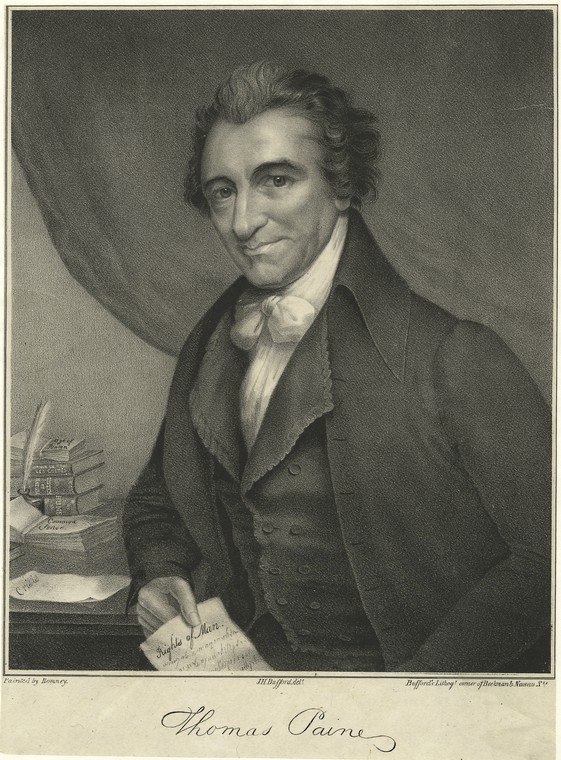
- Thomas Paine
Rebellion in the Colonies
The members of the continental congress were not keen on another tyrannical monarchy. However, the congress did see a growing need for a centralized power, one that could speak on behalf of the proposed union, to negotiate treaties with other countries and for keeping peace between colonies. The Continental Congress wrote the Articles of Federation; it was essentially the first Constitution. It was a League of friendships between the states, that is to say that there was a formal agreement between the states to work together, but it did not grant the congress power over the states or their citizens.[11] The biggest issue with the Federation was its inability to handle crises such as the Shays’ Rebellion; where farmers in Massachusetts engaged in armed revolt against their state government in 1786.[12]
Due to the Revolutionary War, ending in 1783, all of the states were in debt and had raised taxation. This led to further debt for common people. Many farmers lost their belongings and land due to foreclosures, having to ‘sell up’. Daniel Shays was one of the farmers forced to sell half of his farm. Shays saw the effects on his livelihood and other farmers. He blamed the state government and built up a rebellion of over fifty farmers. Shays’ rebels forcibly closed courts to protect land owners who could not pay their debtors. The rebellion ended early 1787.
Fears of State Politicians
The revolt clearly demonstrated the fragility of the state governments control over its people.[13] It showed the states and Continental Congress that a national government was necessary to enforce regulation on citizens and by proxy protect state governments from uprisings.
James Madison spoke of the incident in the Notes of Debates in the Federal Convention of 1787 where he says the insurrection was difficult to suppress.[14] These instances of growing discontent and rebellion among citizens meant that state leaders began to agree that a national government was necessary for their own protection and the good of the USA as a whole. The constitution “gave the federal government the power to ‘raise and support armies.’”[15] This was one of many reasons American citizens were worried about the Constitution and why there was such a large push for a Bill of Rights.
From the American Revolution to the drafting of the Constitution in May 1787, there had been a series of rebellions in the name of liberty and freedom, against the British and the state governments. It is clear that there was a very strong spirit of self-determination and autonomy that the citizens would willingly die fighting to protect. Even the delegates when drafting the Constitution, debated over its terms for four months before thirty-eight out of forty-one delegates signed. The ratification process began as delegates returned to their states in September, to discuss it with their citizenry. By January, five states ratified; other states however, were not willing to do so without a BOR.
The Great Debate: Federalists v Anti-Federalists
The federalists
The federalists, who advocated for a centralized government, thought that enumerating certain rights would make it more likely for a federal government to take liberties that were not listed.
James Madison thought the constitution was protection enough in that it outlined what the government could do. Which essentially implied that those were the parameters in which the government could act. Anything outside of those guidelines was not permitted or would require some form of voting and discussion among the delegates of each colony once again.[16] By not making a point to state personal rights, Madison, John Jay, and Alexander Hamilton believed that the constitution protected personal liberties. A sentiment they shared in eighty-four essays, known as The Federalist Papers. The papers were written to persuade the public and delegates to be in favor of ratifying the constitution without a BOR.[17] They also pointed out that some states already had their own BOR, like Virginia.[18]
The Anti-Federalists
On the opposite side of the argument was the Anti-Federalists, who advocated for a more decentralized form of government with greater protections for individual rights and stronger representation for the states.[19]
Patrick Henry, James Winthrop, Melancton Smith, George Mason, and Samuel Bryan were the leading voices in favor of a BOR. These leaders were joined by a large number of ordinary Americans, particularly small farmers and landowners,[20] shopkeepers, and laborers. The Anti-Federalists did not want to be over governed. Although they already had smaller versions of governance in each state with elite members of the colonies having somewhat more sway and control. To them a federal government felt too much like a monarchy.
The writing which historian Ralph Ketcham says most parallels and confronts The Federalist Papers are those signed under the pseudonym “Brutus”; which “attacks the idea of a large, consolidated republic, he criticizes the parts of the Constitution he considers most dangerous to republic liberty.”[21] He also outlines possible abuses of power and incentives given to military personnel and politicians alike, and points out the issues with taxation that can be made worse through a Federal Government.[22] Common Sense,[23] was still resonating with the citizens of the USA and the sentiments were very much instilled into their identity. Up to this point, the people had fought for their freedom from Britain’s monarchy and had been battling with their own state governments for personal liberty and the protection of their property.

- Ratifying the Constitution
The Bill of Rights Debate
This debate raged on over several months from September 17, 1787 until the Constitution was ratified June 21, 1788. Each state had its own reasons for ratification, but generally, they were influenced by the promise of a Bill of Rights and the need for a stronger central government. James Madison promised to support a BOR during his campaign for a seat in the House of Representatives in 1788. He made this promise to gain a seat in Congress and to address the concerns of the Anti-Federalists, his aim was to make sure that ratification did happen and to prevent a second convention which he believed would undermine the Constitution.[24]
Personal Liberty Focused Bill of rights
Although, many of those concerned were wanting to limit the powers of the national government and deny it power over taxation and the regulation of commerce, Madison’s focus was on personal liberties. Finkelman suggests that James Madison believed in the right to liberty, and that he valued the amendments he ultimately listed. This he believes is the reason Madison could write the BOR while not actually thinking it necessary.[25] Though Madison was given a range of possible amendments, he focused on personal liberty and what he considered inalienable rights. Madison ended up with 20 amendments, twelve of which were agreed to by the Continental Congress. Only then went on to be ratified as the BOR. Madison reconciled his original objection, that rights not included in the BOR could be extinguished, through the 9th amendment that stated:
“The enumeration in the Constitution, of certain rights, shall not be construed to deny or disparage others retained by the people.”
Madison’s promise and fulfilment of that promise brought trust and certainty to the citizens of the USA. Although people still did not want monarchy and centralized governance, they felt that their personal liberties would be protected through the BOR.
Final Thoughts
Through repeatedly fighting, and standing-up for freedom and liberty, the American people have formed an identity of being freedom fighters. People who value their personal liberties and will fight to protect them, even against a greater force. The American Revolutionaries fight for independence against the British was the catalyst to this identity shift. They had won against a power that was extraordinarily larger than them. During the Revolution, influential voices such as Thomas Paine helped shape the way the American people saw government and their own autonomous identity. Common Sense in many ways was a call to arms, a unity and comradery of the people against greater powers.
EFFECTS OF THE Declaration of independence
The Declaration of Independence set a precedent, detailing what the people of America did not want and would fight against, if a power like the British Monarchy attempted to tyrannize the USA again. Thus, strengthening the freedom fighting identity. The popularity of Common Sense and the creation of the Declaration of Independence clearly illustrate the American’s want for self-determination and freedom from tyrannical rule. This became a physical and tangible declaration of the American identity. The instances of growing discontent and rebellion among citizens resulted in state leaders agreeing to a centralized national government for their own protection.
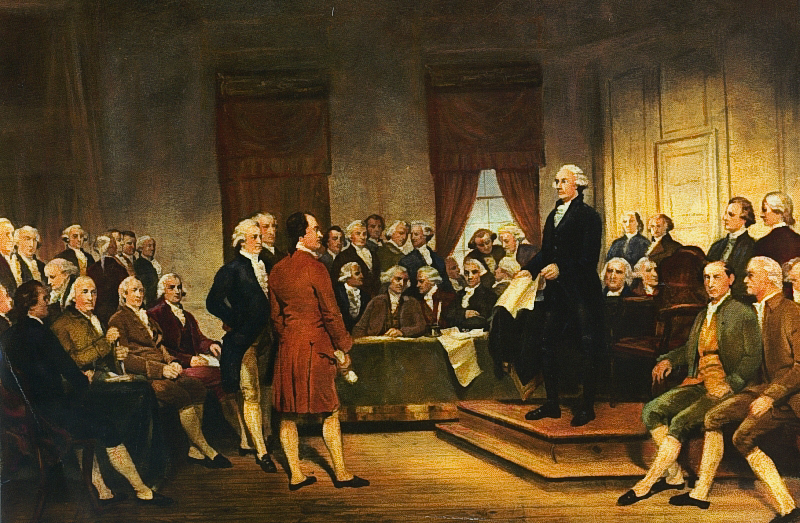
- Signing the Declaration of Independence
The American people realized the implication of the Constitution on their inalienable rights. They refused to agree to the terms of the document without a Bill of Rights. The people’s determination and calls for the protection over their liberties won out in the ratification of the Bill of Rights. Allowing citizens to know exactly what rights they should have no matter what. The BOR served to further solidify the American identity of sovereignty, liberty and freedom; creating lifelong patriots of the USA.
However, there is a centralized institution created to disempower U.S. citizens, which is a threat to democracy, freedom, and sovereignty: Public Mandatory Schooling. (read about the dark roots of the American schooling system here >)
References
[2] US National Archives “The Constitution of the United States: A Transcription” (1787)
[3] Marsh, Esbon R. “The First Session of the Second Continental Congress.” The Historian 3, no. 2 (1941): 183
[4] Ibid
[5] U.S. House of Representatives. “Declaration of Rights and Grievances.” History, Art & Archives. (1774)
[6] King George III “By the King, a Proclamation, for suppressing Rebellion and Sedition.” Massachusetts Historical Society (1775)
[7] Paine, Thomas. Common Sense: The Origin and Design of Government. King Solomon Entreacacias SL. (1776): 13
[8] Feuerherd, Peter. “How Thomas Paine Marketed the Revolution.” JSTOR Daily. (2017)
[9] Paine. Common Sense. (1776): 68-78
[10] US National Archives “Declaration of Independence” (1776)
[11] National Archives, “Articles of Confederation.” (1777).
[12] “The United States and the Articles of Confederation: Drifting toward Anarchy or Inching toward Commonwealth?” The Yale Law Journal 88, no. 1 (1978): 143.
[13] Parker, Rachel R. “Shays’ Rebellion: An Episode in American State-Making.” Sociological Perspectives 34, no. 1 (1991): 96
[14] Parker, “Shays’ Rebellion” (1991): 107
[15] Parker, “Shays’ Rebellion” (1991): 108
[16] Hamilton, Alexander, John Jay, James Madison. The federalist: a collection of essays, written in favour of the new Constitution, as agreed upon by the Federal Convention: in two volumes. American Imprint Collection (1788): LXXXIV
References Continued
[17] Hamilton, et al. The federalist. (1788)
[18] Hamilton et al. The federalist. (1788): XLVI
[19] Ketcham, Ralph. The Anti-Federalist Papers and the Constitution Convention Debates. Signate Classics. (1986). (First published 1787-1788): 231
[20] Ketcham. The Anti-Federalist Papers (1787): I, II, 266-280
[21] Ketcham. The Anti-Federalist Papers (1787): 281
[22] Ketcham. The Anti-Federalist Papers (1787): I, IV, X-XII, and XV 282-328
[23] Paine. Common Sense. (1776)
[24] Finkelman, Paul. “James Madison and the Bill of Rights: A Reluctant Paternity.” The Supreme Court Review (1990): 313
[25] Finkelman. “James Madison and the Bill of Rights.” (1990): 347
Don't miss a beat!
Be part of the EDH Family and Join our Newsletter for exclusive discounts and life changing strategies. Plus get the Family Activities Handbook PDF download straight to your inbox today!
We hate SPAM. We will never sell your information, for any reason.