
Where Did Pirates Come From?
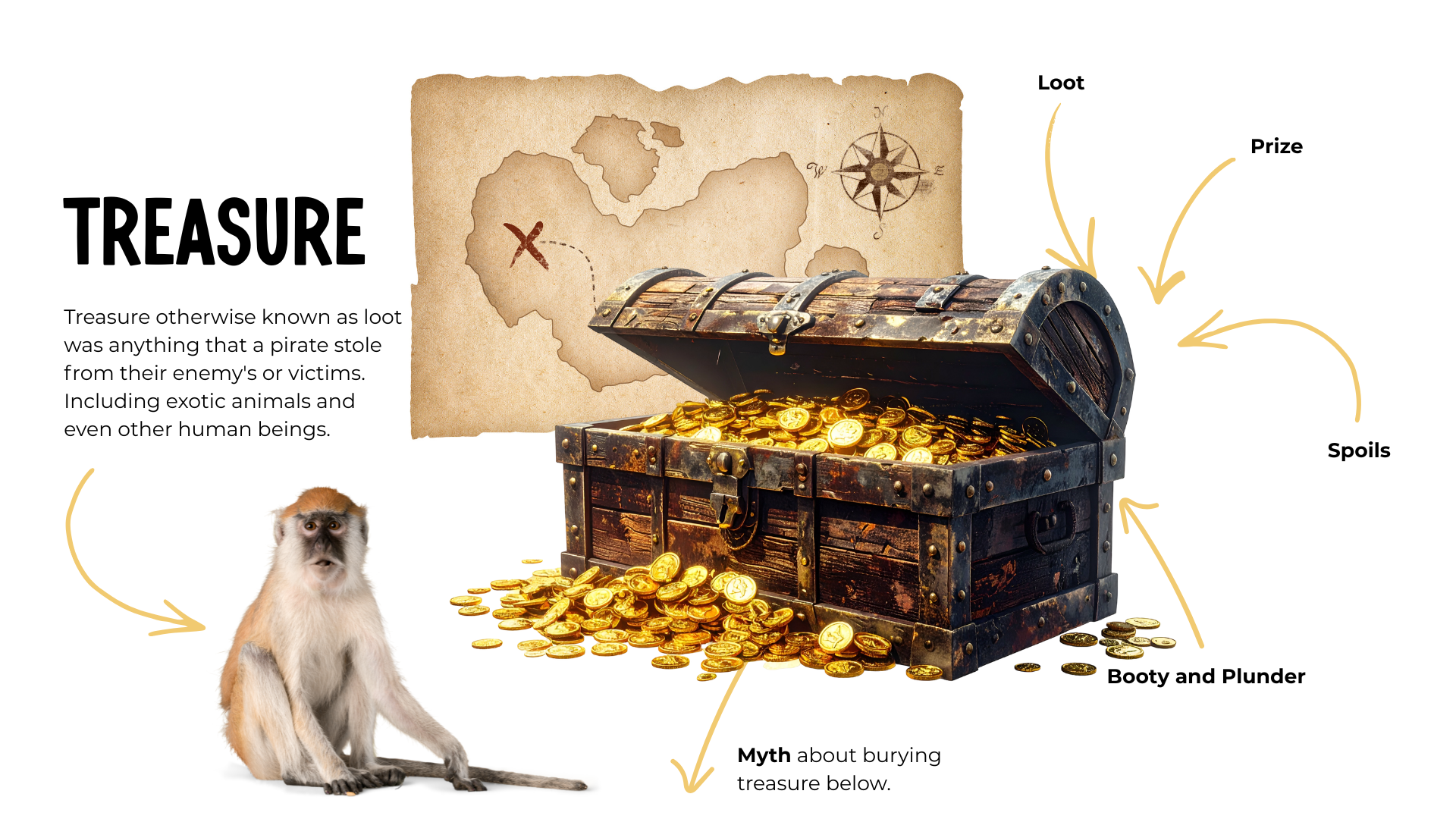
Avast! Me hearties, welcome to the page about pirates. They sailed the seven seas in search of fortune and a better life, a life of freedom. When you think of a pirate I am sure you imagine a man with a wooden leg, an eye patch over one eye and a map hidden within the folds of his cloak like coat. There are however many details about pirates that have become part of our story telling yet weren't actually historically accurate. For instance, if you think pirates used to always bury their treasure, think again. Burying treasure was not something they did unless absolutely necessary to protect their loot as often loot was perishable. Food and clothing didn't age will in a box buries, rarely was look only gold and gems. More commonly loot was odd pieces of jewellery food, medicine and whatever else might come in handy in life and survival.

Learn

Project Prompts

Quiz Time

Story

Watch
What is a Pirate?
Pirate is a name given to those who engage in acts of piracy. Piracy is any robbery or other violent action, that is committed outside of the normal jurisdiction of state, which means these actions are committed on the sea or in the air, for personal gain and without permissions from public authorities. pirates that we will talk about here are the kind to attack ships regardless of nationality, during both times of war and times of peace for the sole purpose of thievery and or revenge.
Because piracy has been regarded as an offense against the law of nations, the public vessels of any state have been permitted to:
- seize a pirate ship, to bring it into port,
- to try the crew (regardless of their nationality or domicile),
- and, if they are found guilty, to punish them and to confiscate the ship.
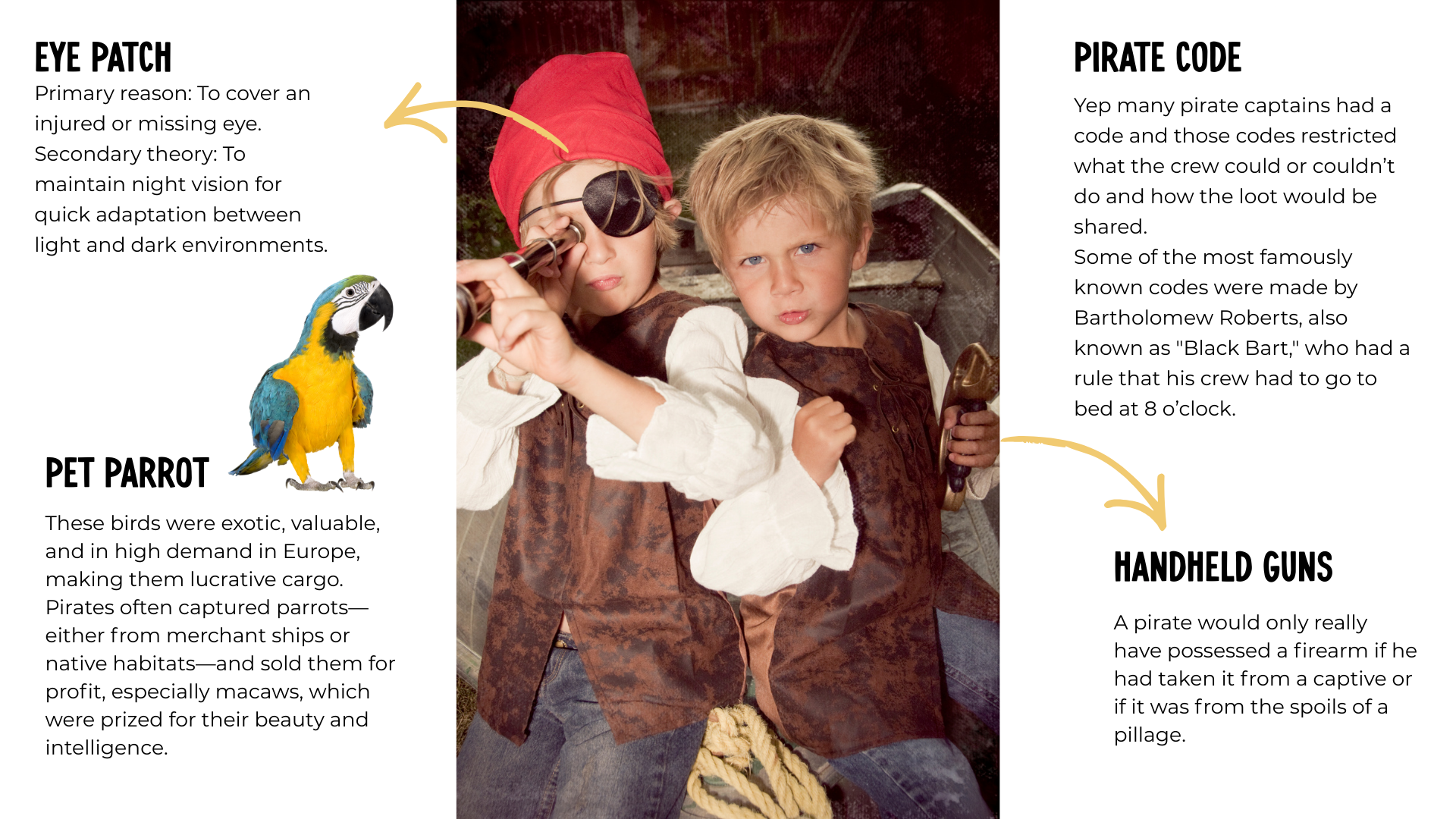
More on Weapons on World History Encyclopaedia here>
Origins of Piracy
Before people took to the seas we had murder and thievery on land so when travel could be done by sea it only makes sense that thievery, murder and so much more would carry on out at sea too.
Also much of the popular knowledge on pirates; what they did and who they were, stems from fictional depictions, especially Robert Louis Stevenson’s Treasure Island (1883), which introduced Long John Silver—the archetype of the modern pirate—and popularized the trope.
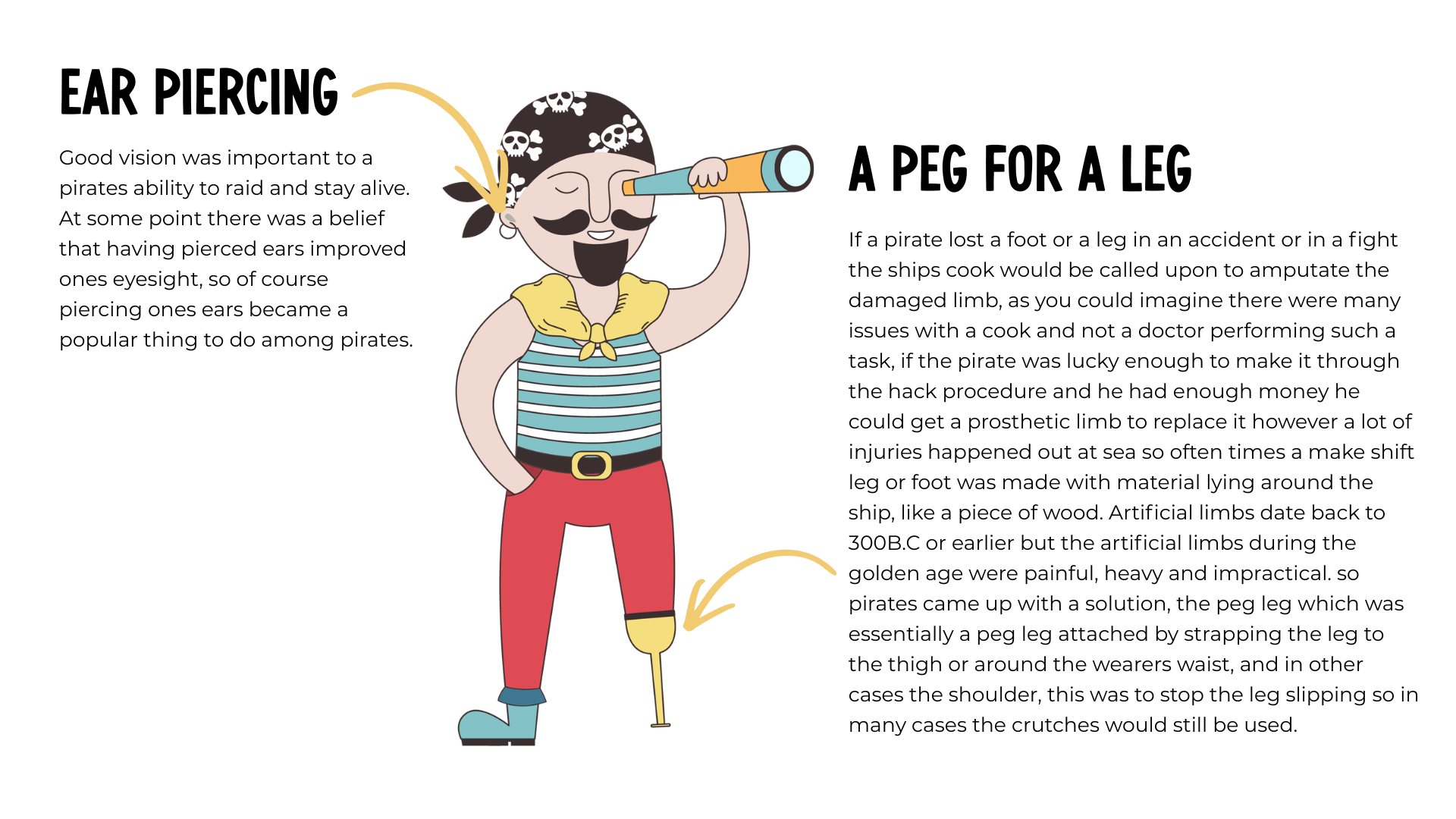
What are the Different Types of Pirates?
There are a variety of different types of pirate, each had their own era, philosophies and each captain had their own pirate code, though some codes were universal across all pirating. These names cannot be used interchangeably, as they each carry their own meaning.

Corsairs
- Corsairs came about in the 19th century
- They sailed along the Mediterranean
- They were very strategic in their attack and thievery, they spent time scoping out a ship, its valuables, weapons, crew. this scouting process could take hours and even days. The captain looking through a spyglass.
- Corsairs after observing a ships weaponry might avoid the other ship through fear of being defeated by superior weaponry.

Vikings
- Viking is old English for pirate
- They came about in the early 8th to the12th century
- Many of these pirates roamed the North Sea
- These Scandinavian warriors wouldn't just raid other ships but would also raid villages inland, not just on their shipping routes.
- They openly allowed both males and females to join
- Valkyrie, was a name often given to female vikings. This name came from the Norse goddesses who rode into battle to escort dead warriors to Valhalla.

Buccaneers
- Initially French and English game hunters Buccaneers were also known as freebooter and filibuster..
- They lived in the Caribbean, or more specifically, on the island of Hispaniola
- They came about in the 16th century.
- These men were social outcasts (religious or political refugees, criminals, exiles, deserters, runaway slaves, and indentured servants)
- They lived off wild pigs and cattle.
- The name buccaneers came from the word boucans which was the art of smoking meat over a fire on green sticks
- At first these men would only, trade with passing merchants, exchanging goods for meat. The Spanish ships that came by were brutal to these men and thus the deep hatred began to form. The men began to actively attack Spanish ships and settlements. Through the attacks, and thievery, they learned that piracy was a much easier way to live.

Privateers
- Considered a section of the state navy, pirateers were civilian men, legally commissioned, by government officials during times of war, to attack an enemy city or ship.
- Although these privateers were also known as gentlemen pirates, as they originally only attacked enemy ships and were seen as a more dignified version of a pirate, their true non-gentlemanly ways became apparent, as they often gave into the temptation to fight non-enemy ships. This is one of many reasons why they're not well-respected today.
- The french refereed to these types of pirates as our first mentioned pirates, Corsairs. It was said that these men crossed the fine line between gentleman and pirate.
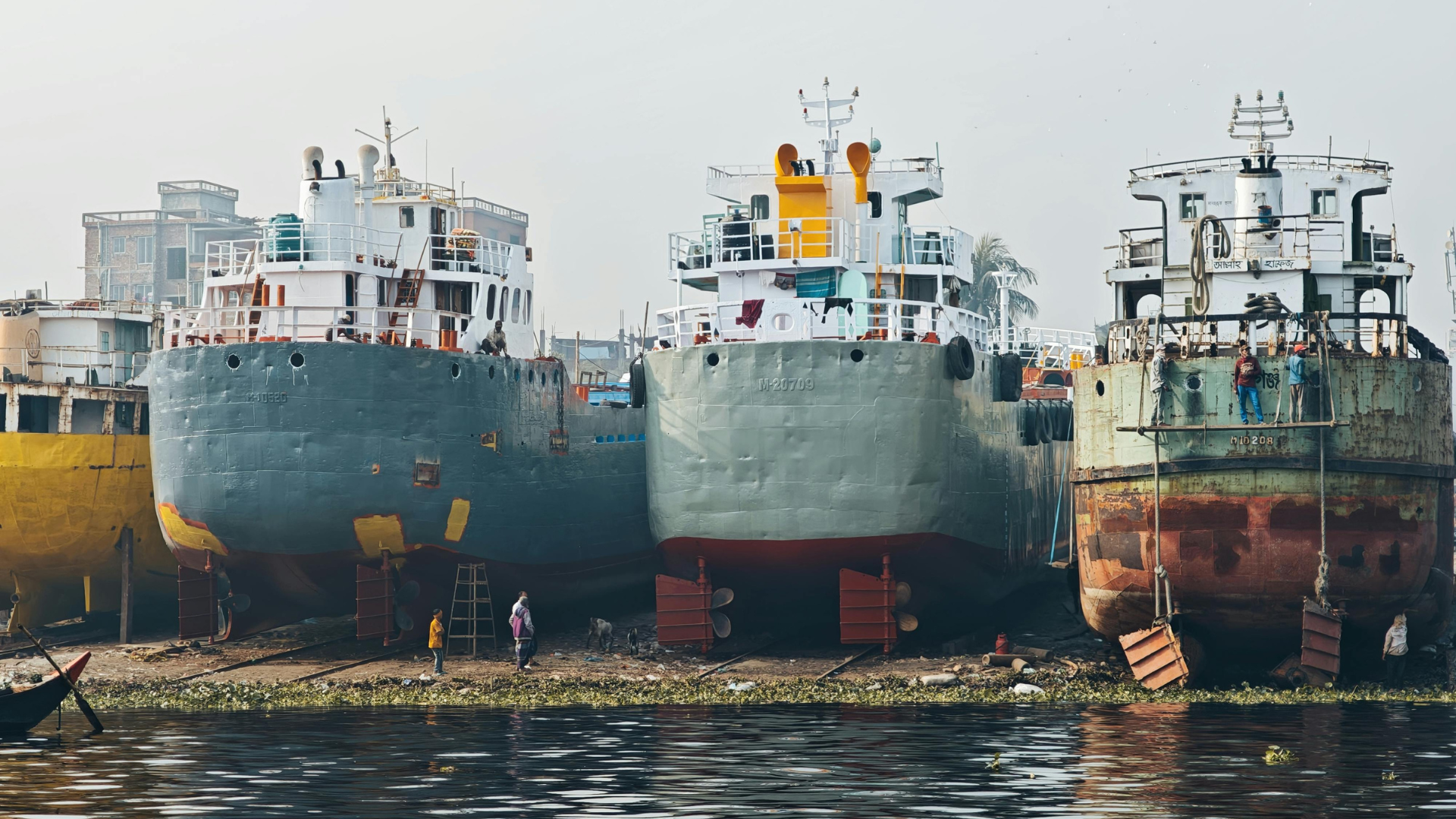
Modern Day Pirates
Some believe that organised piracy no longer exists but of course it does, piracy today occurs primarily around shipping lanes and mostly in the Indian Ocean, the South China Sea and East Africa. Many pirates of today, use speed ships instead of large sail ships so they can easily escape sea patrol and instead of cannons and cutlasses, they use something like an AK 47 automatic machine gun which is, in many ways more destructive. They're also know for human trafficking which is the recruitment, transportation, transfer, harbouring, or receipt of people through force, fraud, coercion, or deception for a purpose, generally for money or influential standing. Human trafficking is done for all sorts of reasons some include labour, crime, and marriage. Often the victim is treated poorly and can end up sick or dead from injury. Human trafficking is a multi-billion dollar criminal industry, estimated to involve 24.9 million victims globally, with women and girls making up the majority of victims. It is a serious violation of human rights and a pressing public health and safety issue. There are numerous organizations and combat offences working to free survivors and bring the culprits to justice.
Burying treasure
This is a somewhat myth as it wasn't the norm in the pirate world to bury ones loot, the concept of buried plunder was popularized by author Robert Louis Stevenson’s 1883 novel “Treasure Island,” but David Cordingly a maritime historian believes these pirates weren't that frugal. It is presumed that pirates spent the money they stole as they were reported to have lived lavishly squandering there spoils on women, alcohol and gambling. So, buried treasure wasn't necessarily a common practice for pirates, however there are a few reliable accounts of pirates actually burying their loot, the purpose of the burial was to protect their stolen goods from being confiscated by authorities and to be seen as innocent if the authorities came across their ship. If they buried treasure, it was with the knowledge they would soon dig-it-up and have it back aboard their ship for spending and or selling.
- English privateer Francis Drake after a 1573 raid of a Spanish mule train, was said to have left several tons of gold and silver along the Panamanian coast with some guards. It is said that he quickly retrieved the booty after rendezvousing with his ships.
- Captain William Kidd a privateer-turned-pirate who became a WANTED man. Dropped anchor in 1699 near New York and buried the equivalent of millions of dollars in gold and jewels on an island. he was arrested in Boston while trying to clear his name, authorities tracked down and confiscated his treasures and Kidd was executed by hanging in London.
Why we Associate Treasure with Pirates
Story telling turned to legend as people shared stories of pirates hoarding long lost riches on deserted desert islands. Possibly on of the most famous is the "Treasure of Lima" said to have been buried on Costa Rica’s Cocos Island around 1820. The treasure consists of Spanish gold, silver and jewels worth around $200 million today, and was supposedly stolen by a British ship captain named William Thompson. but despite decades of searching, by would-be treasure hunters, the treasure has yet to tracked down.

A Pirate Raid
Some pirates would burn a ship after a raid.
The Golden Age of Piracy
- During the mid 16th to the early18th century pirates were at their most dangerous, although they had existed for centuries before this, this was the period that became known as 'The Golden Age of Piracy'.
- Pirate ships were a democracy, though they were run by their captain there was a mutual understanding and agreement of the code aboard the ship and meetings conducted. Pirate captains were seen as more considerate than that of say the navy. The navy was no place for democracy, only strict guidelines and rules.
- Though some things were more fare aboard a pirate ship, the life wasn't easy, it was lonely, hard-work and full of a constant threat of harm and death. Many chose the life because their current situation wasn't favorable, like them working in the navy, having an extremely low wage or living life as a slave, some young lads, however, seek adventure and believed they would find it aboard a pirate ship and then there were those after riches and this was never found in a lifestyle such as piracy as all of the loot was shared and squandered. The captain wouldn't accept any man seeking to become a pirate. If a recruit had a wife or children he was denied a place and turned away.
Bartholomew Robert's Articles/Code
ARTICLE I. Every man shall have an equal vote in affairs of moment. He shall have an equal title to the fresh provisions or strong liquors at any time seized, and shall use them at pleasure unless a scarcity may make it necessary for the common good that a retrenchment may be voted.
ARTICLE II. Every man shall be called fairly in turn by the list on board of prizes, because over and above their proper share, they are allowed a shift of clothes. But if they defraud the company to the value of even one dollar in plate, jewels or money, they shall be marooned. If any man rob another he shall have his nose and ears slit, and be put ashore where he shall be sure to encounter hardships.
ARTICLE III. None shall game for money either with dice or cards.
ARTICLE IV. The lights and candles should be put out at eight at night, and if any of the crew desire to drink after that hour they shall sit upon the open deck without lights.
ARTICLE V. Each man shall keep his piece, cutlass and pistols at all times clean and ready for action.
ARTICLE VI. No boy or woman to be allowed amongst them. If any man shall be found seducing any of the latter sex and carrying her to sea in disguise he shall suffer death.
ARTICLE VII. He that shall desert the ship or his quarters in time of battle shall be punished by death or marooning.
ARTICLE VIII. None shall strike another on board the ship, but every man's quarrel shall be ended on shore by sword or pistol in this manner. At the word of command from the quartermaster, each man being previously placed back to back, shall turn and fire immediately. If any man do not, the quartermaster shall knock the piece out of his hand. If both miss their aim they shall take to their cutlasses, and he that draweth first blood shall be declared the victor.
ARTICLE IX. No man shall talk of breaking up their way of living till each has a share of £l,000. Every man who shall become a cripple or lose a limb in the service shall have 800 pieces of eight from the common stock and for lesser hurts proportionately.
ARTICLE X. The captain and the quartermaster shall each receive two shares of a prize, the master gunner and boatswain, one and one half shares, all other officers one and one quarter, and private gentlemen of fortune one share each.
ARTICLE XI. The musicians shall have rest on the Sabbath Day only by right. On all other days by favour only.
Learn to Speak Like a Pirate
ahoy - hello
Avast ye! - Stop you!; pay attention!
Blimey –surprise
Heave ho – using your strength to do something
Savvy? - “Do you understand?”
Shiver me timbers! - shock or disbelief
Sink me! - great surprise
Yo ho ho - a chant when doing strenuous work, or to call attention to the speaker
Briney deep - the ocean
Peg leg - a wooden leg
Run a rig - play a trick
Sea legs - when once can comfortably walk on a moving ship

The Pirate Captain
BY TONI VERNON
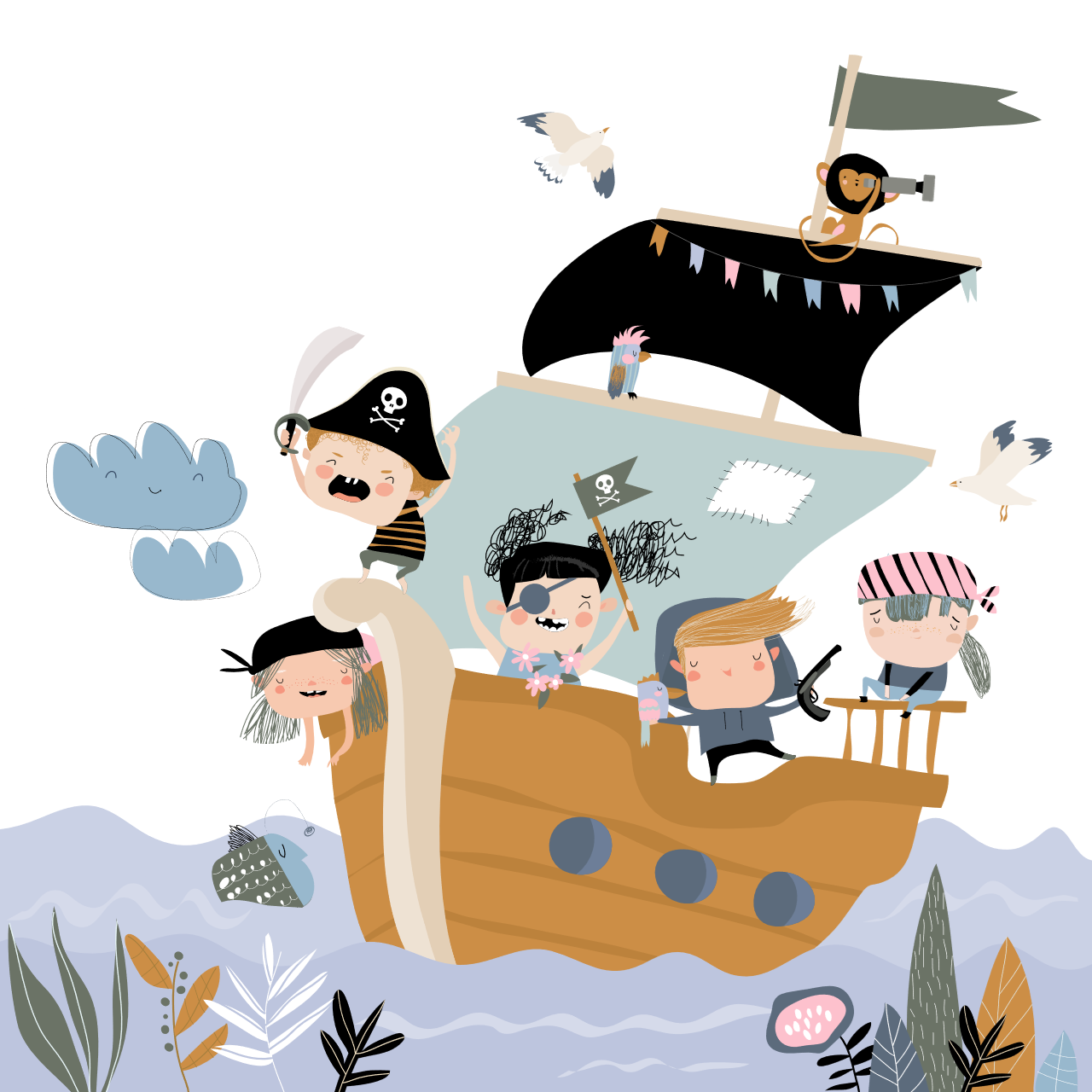
Flap flap, go the sails of the little blue boat,
Filling with wind like the Pirate Captain’s coat.
The captain is happy, sipping his tea.
And what does he see, swimming in the sea?
A shark! A shark! It comes oh so near.
The shark is hungry and can smell their fear.
The captain shouts, “Ready the plank!”
When done, the captain says, “Thanks!”
Who will walk the plank? Henry Bime.
Henry begs, “I promise I’ll go to bed on time.”
“But it’s too late for that,” the captain replies.
They crew has had enough of Henry’s lies.
They push him on the plank of wood,
He yelps, “I promise I’ll be good!”
The shark opens its mouth as it waits.
“Oh, please! Aren’t you all my mates?
I promise to scrub the floors and what’s more,
I’ll even give you my loot, for sure!”
The crew nod their heads. Henry comes back,
Glad he has escaped the shark’s attack.
Project Prompts and Ideas
- Write an article on a pirate
- Write a short story about being a shipmate aboard a pirate ship.
- Write a news report on a traditional/modern day pirate
- Write a brochure pamphlet convincing someone to stay on a pirate ship for their next holiday.
- Use the poem story as inspiration and write a short story from the sharks point of view. Does the shark have a family? Is the shark desperate for food? Does the shark like humans? Does the shark have any hobbies?
- Write a short story/diary entry from a pirates point of view.
- You're a pirate captain write your own pirate code. use tea bags or coffee to stain your piece of paper then use ink, paint or pen to write your rules. Tip: write your rules down on a scrap piece of paper before writing them on your final poster. You can also use pencil first and trace your pencil template in the ink/paint or pen. Consider: How will the captain act when a rule is broken?
- You're a pirate captain make a poster advertising a need for more crew on your ship
- You are a chef on a pirate ship make a menu for the canteen
- Read the pirate story and follow the prompts
- Create your own diagram of a pirate ship on an A3 piece of paper adding more details and description of each part.
If you're a Children's Hub + Member you can submit your project here > for marking and if you have permission you can tick the option to share it in our member projects area so other children in the membership can be inspired by your work too.

Great Videos About Pirates
Here are a select few videos about pirates and what they got up to in their most notorious time.

Citations
- Duncombe, L.S. (2017 April 1), Pirate Women: The Princesses, Prostitutes, and Privateers Who Ruled the Seven Seas. Chicago Review Press. ISBN : 1613736010
- Boissoneault, L. (2017 April 12), The Swashbuckling History of Women Pirates,
- Smithsonian Mag https://www.smithsonianmag.com/history/swashbuckling-history-women-pirates-180962874/
- Miller-Wilson, K. Pirate Terms and Phrases https://reference.yourdictionary.com/resources/pirate-terms-phrases.html
- Johnson, C.C. (2012 September 16). A General History of the Pyrates
- Konstam, A. (2009 October 1).The World Atlas of Pirates: Treasures and Treachery on the Seven Seas--in Maps, Tall Tales, and Pictures.
- Cordingly, D. (2006 May 9). Under the Black Flag: The Romance and the Reality of Life Among the Pirates.
- Minster, C. (2019 July 21). Biography of 'Black Bart' Roberts, Highly Successful Pirate. ThoughtCo, https://www.thoughtco.com/bartholomew-black-bart-roberts-2136212
- Mancini, M. (2014 September 18). 11 Rules from an Actual Pirate Code. Mental floss. https://www.mentalfloss.com/article/58900/11-rules-actual-pirate-code
- Cartwright, M. (2021, September 07). Bartholomew Roberts. World History Encyclopedia. https://www.worldhistory.org/Bartholomew_Roberts/
- Lewis, B.R. (2008 November 25). The Pirate Code: From Honorable Thieves to Modern-Day Villains
- Jenkins, J.P. Piracy, international law. Britannica. https://www.britannica.com/topic/piracy-international-law
- Organised Crime-Maritime Piracy, Smuggling and Human Trafficking. Bartleby Research. https://www.bartleby.com/essay/Organised-Crime-Maritime-Piracy-Smuggling-and-Human-F383J94CDM6A
- Andrews. E. (2015, 4 Nov) Did pirates really bury their treasure? History. https://www.history.com/news/did-pirates-really-bury-their-treasure
-
Blue Campaign: What Is Human Trafficking? https://www.dhs.gov/blue-campaign/what-human-trafficking